Why urinary stone treatment does not always start with surgery: a guideline-based sequence
Hello, I’m Dr Shin Chan-wook, a urology specialist and director of Mediraum Clinic in Naeoe-dong, Gimhae. Today I would like to explain the order in which treatments are chosen for urinary stones. I will describe the criteria I use to distinguish observation, extracorporeal shock wave lithotripsy, and referral for urinary stone surgery.
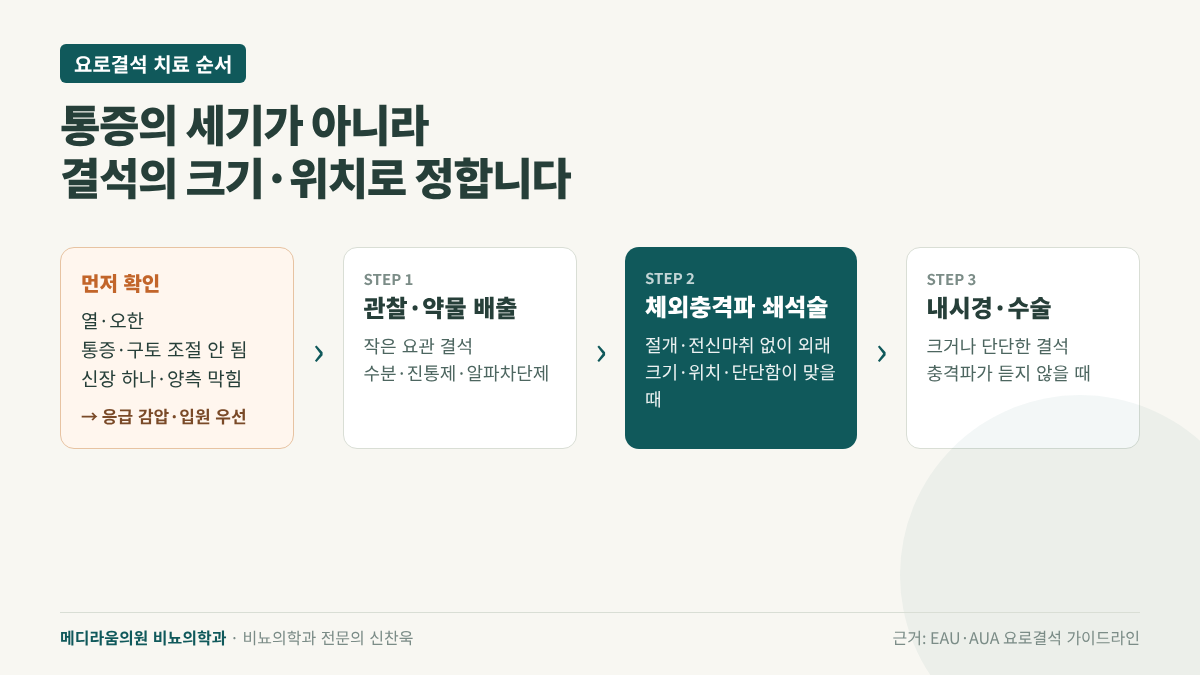
Severe pain from a urinary stone—whether a ureteral or kidney stone—does not mean that treatment should begin with surgery. Treatment is selected according to the stone’s size and location and whether infection is present, not simply the intensity of pain. For a stone around 4 mm, I generally begin with observation. For most stones from 5 mm to 2 cm, I recommend extracorporeal shock wave lithotripsy. If the stone is larger or remains after 2–3 sessions, I discuss endoscopic surgery.
“The pain is this severe. Don’t I need surgery?”
This is the question I hear most often in the clinic. Severe pain is commonly assumed to mean that the stone is large, but this is not necessarily true. Stone pain is not caused simply by the stone piercing tissue. It occurs when the stone blocks the ureter, urine accumulates above the obstruction, and the ureter suddenly stretches. It resembles the pulling pain in a muscle during a deep stretch. A small stone can therefore cause extreme pain when it tightly blocks a narrow point, while a large stone sitting quietly in the kidney may cause almost no pain.
Pain is controlled with analgesics, while the treatment method is selected by assessing the stone.
Four factors that determine whether urinary stone surgery is needed
- Size — A small stone may pass on its own.
- Location — Treatments work differently for a stone in the kidney, upper ureter, or lower ureter.
- Infection and kidney function — When fever is present or kidney function is impaired, emergency drainage comes before stone removal.
- Patient circumstances — We also consider pain control, work and schedule, and current medicines such as anticoagulants.
Options are considered step by step before urinary stone surgery
① Observation and medical expulsive therapy
A small ureteral stone can be observed with fluids and analgesics while waiting for spontaneous passage. The European Association of Urology (EAU) guideline offers an alpha-blocker as an option for medical expulsive therapy for a distal ureteral stone measuring 5 mm or larger. Korean National Health Insurance criteria also use about 1 week of observation as the general rule for a lower ureteral stone smaller than 4 mm. Even for a stone around 4 mm, I perform a procedure if observation brings no improvement or the pain is severe.
② Extracorporeal shock wave lithotripsy
This treatment focuses shock waves generated outside the body to break the stone into small pieces. It requires no incision or general anaesthesia, is performed as an outpatient procedure, and allows the patient to go home the same day. Mediraum Clinic in Naeoe-dong, Gimhae, provides outpatient extracorporeal shock wave lithotripsy. I recommend it for most stones measuring about 5 mm to 2 cm, with at least 7 full days between sessions. Most stones pass progressively over successive sessions. If a stone remains after 2–3 sessions, I discuss the next step with the patient. The treatment-day process is described in What happens on the day of extracorporeal shock wave lithotripsy, and how long does it take?
The EAU guideline explains that success with shock wave lithotripsy depends on the stone’s size, location, and hardness and on body habitus. I use X-ray and contrast imaging to assess the location of the stone and the degree of obstruction before choosing the procedure. If contrast imaging cannot be performed and CT is essential, I refer the patient to a higher-level hospital.
③ Urinary stone surgery (endoscopy)
Endoscopic surgery, such as retrograde intrarenal surgery (RIRS), is more appropriate when a stone is large or hard or remains after 2–3 shock wave sessions. I also refer directly to a higher-level hospital when stones are present on both sides or their location cannot be identified with contrast imaging. The American Urological Association (AUA) guideline offers both shock wave lithotripsy and ureteroscopy as options for an upper ureteral stone smaller than 2 cm when an intervention is needed. I also make it clear that shock wave treatment is not suitable for every stone.
If surgery has been recommended, understand the options before deciding
Endoscopic surgery directly visualises and removes the stone, so it has a greater chance of resolving the problem in one procedure. It usually requires admission and anaesthesia, however, and therefore places a greater burden on the patient’s schedule. Urinary stones can also recur throughout life. Repeated surgery with each recurrence creates a cumulative surgical history. In Korea, previous surgery may need to be disclosed during insurance underwriting and, depending on the insurer, may lead to an exclusion for the affected body part.
If a stone is likely to respond to shock wave treatment, I therefore explain that option first. Conversely, if the size or location makes endoscopy more appropriate, I refer the patient from the outset. There is no single method that is always better; what matters is understanding and choosing the method that fits your stone.
When emergency drainage comes before outpatient treatment
- A temperature of 38°C or higher or chills, suggesting an infected stone
- Vomiting that prevents drinking water and pain that is not controlled with analgesics
- Passing almost no urine
- Obstruction when only one kidney is present
In these circumstances, go straight to the emergency department. Detailed criteria are provided in Sharp pain in the flank or lower abdomen.
Plan on preventing recurrence
Care does not end when the stone is removed; prevention begins at that point. I analyse the composition of a passed stone and use medicine when indicated. The most important daily measure is water. See also Preventing urinary stone recurrence: water, not beer.
Frequently asked questions
Can a urinary stone pass on its own?
A small stone can pass on its own. For a stone around 4 mm, I begin with observation. If it does not improve with time or the pain is severe, I perform a procedure. The larger the stone, the less likely it is to pass spontaneously.
At what size is a procedure used for a urinary stone?
I recommend shock wave lithotripsy for most stones measuring about 5 mm to 2 cm. Even a stone around 4 mm may be treated when pain is severe or it does not improve over time.
How many shock wave treatments are needed?
Some stones are treated in one session, but many require several sessions. I leave at least 7 full days between sessions and discuss endoscopic surgery if the stone remains after 2–3 sessions.
Is urinary stone surgery always necessary?
Endoscopic surgery is appropriate when a stone is large, hard, or does not break with shock wave treatment. Many other stones can be managed with observation or shock wave lithotripsy.
Related care: Urinary stone care
Related articles
- What happens on the day of extracorporeal shock wave lithotripsy, and how long does it take?
- Urinary stone treatment: make an informed choice
Guidelines and references
- EAU Guidelines on Urolithiasis (2026)
- AUA Surgical Management of Kidney and Ureteral Stones (2026)
- Health Insurance Review and Assessment Service, coverage criteria for extracorporeal shock wave lithotripsy (Ja-350), Notice No. 2015-185
By Dr Shin Chan-wook, urology specialist at Mediraum Clinic, Naeoe-dong, Gimhae.
This article provides general health information. The tests and treatment you need depend on your symptoms and circumstances. Consult a clinician for an individual assessment.