Kidney stone pain in Gimhae: sharp flank or lower abdominal pain and when to go straight to the emergency department
Hello, I’m Dr Shin Chan-wook, a urology specialist and director of Mediraum Clinic in Naeoe-dong, Gimhae. Today I would like to explain how we check for a urinary stone when severe flank or lower abdominal pain begins suddenly. I will distinguish when you should go straight to the emergency department from when an outpatient appointment is appropriate.
If severe tearing pain suddenly begins in the flank and radiates to the lower abdomen or groin, a urinary stone—usually a ureteral stone, often called a kidney stone—is one of the first conditions to suspect. If fever accompanies the pain or any other warning sign listed below applies, go straight to the emergency department. If there are no warning signs and pain medicine controls the pain, you may attend a urology outpatient clinic the next day. The disappearance of pain does not prove that the stone has passed, so follow-up imaging is still necessary.
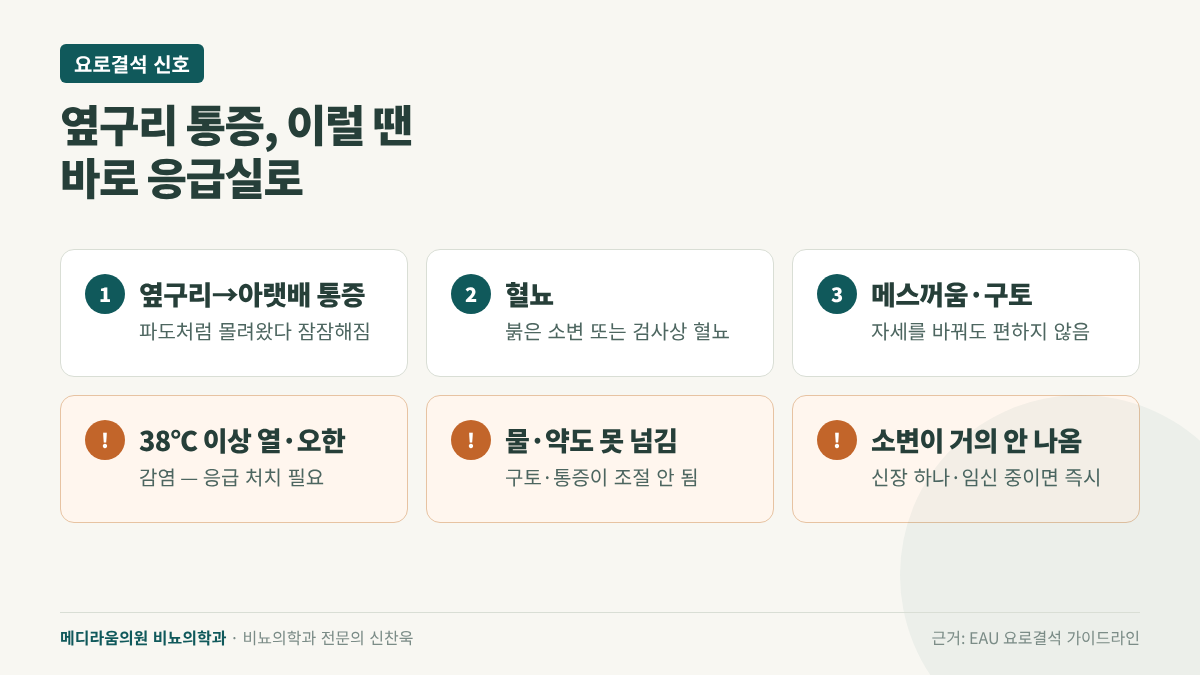
Symptoms that suggest a urinary stone
- Severe tearing pain in the flank that radiates to the lower abdomen or groin
- Pain that comes in waves, settles, and then returns
- No comfortable position, even after changing posture
- Red urine or blood detected on a urine test
- Nausea or vomiting
- Frequency and a feeling of incomplete emptying when the stone moves close to the bladder
Why does flank pain hurt so much?
The common assumption is that a sharp stone hurts because it scratches the ureter, but the mechanism is different. When a stone blocks the narrow tube carrying urine from the kidney to the bladder, urine accumulates above it. The ureter and kidney suddenly stretch, causing pain. It resembles the pulling pain in a muscle during a deep stretch. Even a small stone can therefore cause severe pain when it creates a tight obstruction.
Is it a stone, a spinal disc problem, muscle pain, or appendicitis?
Flank pain can be confused with a spinal disc problem, muscle pain, appendicitis, or pyelonephritis. In the clinic, I consider where the pain began and how it changed, the examination findings, and the location of the pain, then use urinalysis and X-ray imaging. It is difficult to make this distinction yourself from a few symptoms. Assessment by an experienced urology specialist is the quickest route to an answer.
Emergency department now or outpatient clinic the next day?
Go straight to the emergency department when:
- You have a temperature of 38°C or higher or chills. Infection behind an obstructed kidney can progress to sepsis.
- You are passing almost no urine.
- Vomiting prevents you from keeping down water or medicine.
- Pain is not controlled despite taking pain medicine.
- You have only one kidney or you are pregnant.
The European Association of Urology (EAU) guideline identifies an obstructed kidney with signs of urinary infection and/or no urine output as an emergency. Urgent drainage using a ureteral stent or nephrostomy may be needed before definitive stone treatment, especially when infection is present.
You may attend an outpatient clinic the next day when:
If you have no fever, none of the warning signs above apply, and pain medicine controls the pain, attending a urology outpatient clinic the next day may be preferable to remaining in the emergency department overnight. In Korea, patients assessed as non-emergencies may have to pay the emergency medical management fee themselves, creating a substantial cost. In the outpatient clinic, evaluation of the stone can proceed directly to extracorporeal shock wave lithotripsy when indicated.
Less pain does not mean the problem is over
Pain can settle when the stone moves slightly or pressure is partly relieved. A patient can also stop feeling pain as the body adapts despite continued obstruction. In a study cited by the American Urological Association (AUA) guideline, a stone was still present in 26% of patients with a ureteral stone who had been pain-free for at least 3 days. Prolonged obstruction can impair kidney function, so follow-up imaging is needed even when the pain has disappeared.
Tests performed in the clinic
We first use urinalysis, X-ray imaging, and examination to assess whether a stone is likely. When a stone is suspected, contrast imaging is used to determine its location and the degree of obstruction. Drinking a large amount of water can make contrast imaging less accurate, so if you have decided to attend the clinic, do not deliberately drink excessive water beforehand. If contrast imaging cannot be performed and CT is essential, I refer the patient to a higher-level hospital. At Mediraum Clinic in Naeoe-dong, Gimhae, a confirmed stone can be treated with extracorporeal shock wave lithotripsy on the same day as an outpatient procedure. The sequence of treatment is explained in Why urinary stone treatment does not always start with surgery.
Frequently asked questions
Should flank pain send me to the emergency department?
Go straight to the emergency department if you have a temperature of 38°C or higher or chills, are passing almost no urine, cannot keep down water because of vomiting, have pain that is not controlled by pain medicine, have only one kidney, or are pregnant. If none of these applies and pain medicine controls the pain, you may attend an outpatient clinic the next day.
Can I manage urinary stone pain with pain medicine?
If you have no fever or other warning signs and the pain is controlled, you may wait until an outpatient appointment the next day. However, the stone can remain after the pain settles, so follow-up imaging is still necessary.
How can flank pain be distinguished from a spinal disc problem?
It is difficult to distinguish the causes from symptoms alone. In the clinic, we review the history, examination findings, and pain location and use urinalysis and X-ray imaging.
The flank pain has stopped. Do I still need to attend?
Yes. The disappearance of pain does not mean that the stone has passed. Continued obstruction can impair kidney function, so follow-up imaging is needed.
Is red urine dangerous?
A stone can cause bleeding by irritating the ureteral wall. Seek prompt care if fever or inability to urinate occurs as well. Testing is needed because red urine can also have causes other than a stone. See If you see blood in your urine.
Related care: Urinary stone care
Related articles
- Why urinary stone treatment does not always start with surgery
- What happens on the day of extracorporeal shock wave lithotripsy, and how long does it take?
Guidelines and references
By Dr Shin Chan-wook, urology specialist at Mediraum Clinic, Naeoe-dong, Gimhae.
This article provides general health information. The tests and treatment you need depend on your symptoms and circumstances. Consult a clinician for an individual assessment.