When should you see a urologist? An accurate diagnosis matters more than embarrassment
Hello, I’m Dr Shin Chan-wook, a urology specialist and director of Mediraum Clinic in Naeoe-dong, Gimhae.
Today I would like to explain which symptoms should prompt a visit to urology. I will cover urinary problems and pain, concerns about sexual health, and the principles I follow in clinical care.
If urination is difficult, it burns when you urinate, your flank or lower abdomen hurts, you see blood in your urine, or you are concerned about sexual health, urology is the appropriate specialty. A problem may become more serious while a patient delays care out of embarrassment. There are cases in which I genuinely wonder, “Why did this patient have to wait so long?”
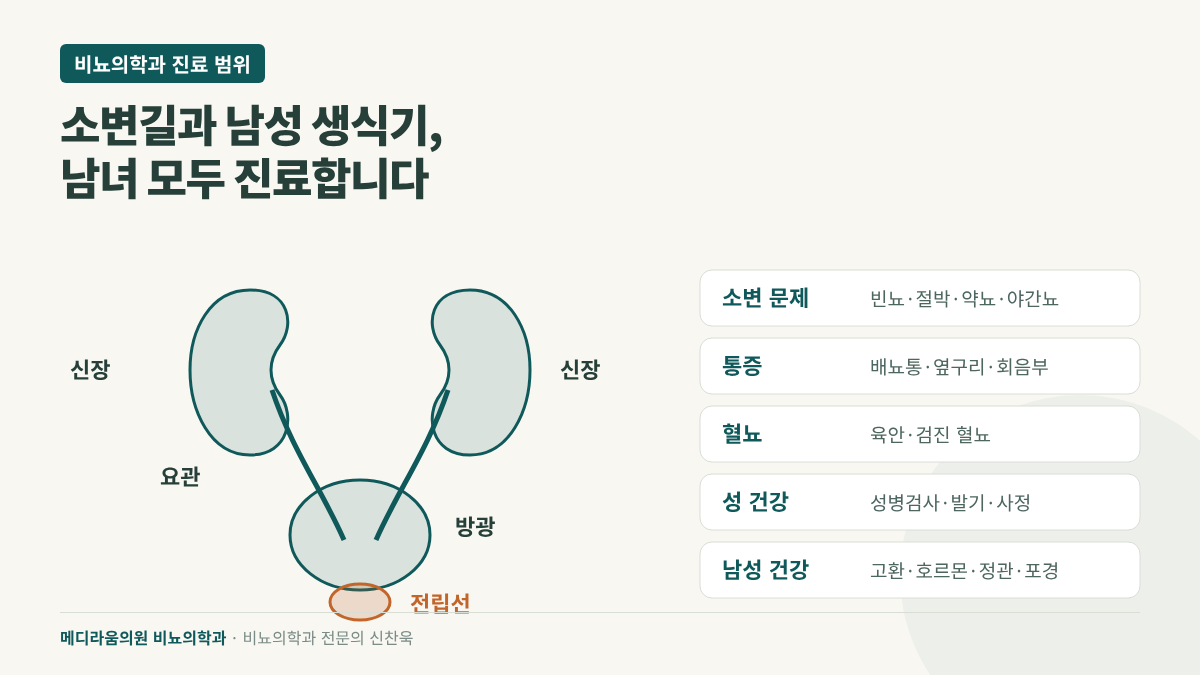
Which parts of the body does urology cover?
“Can I come to urology with this symptom?” is a question I hear often. Urology treats the system that makes and carries urine—the kidneys, ureters, bladder, and urethra—as well as the male reproductive organs, including the prostate and testes. Care is provided to women and men of all ages, including children.
You can also review the specialty and academic activities of urology on the Korean Urological Association website.
Consider seeing a urologist for these symptoms
- Urinary problems — frequency, urgency, a weak stream, waking at night, or a feeling of incomplete emptying
- Pain — burning during urination or pain in the flank, lower abdomen, or perineum
- Blood in the urine — red urine or blood detected during a health check
- Sexual health — concern after sexual contact, discharge, a lesion, or erection or ejaculation problems
- Men’s health — testicular pain or a lump, symptoms of low testosterone, or consultation about vasectomy
- Children — genitals or testes that appear small, or a testis that cannot be felt
The same symptom can have different causes
Even a single symptom such as frequent urination can have several causes, including overactive bladder, cystitis, a prostate condition, a stone, or diabetes. In the clinic, I often see a patient who expected simple overactive bladder but whose examination identifies prostatitis. Just as different causes of a headache require different medicines, the cause matters here as well. I therefore investigate the cause before prescribing medicine based on the symptom alone.
Cases that make me wonder why care was delayed
- BPH presenting only after urine has become completely blocked — If the patient had come when the stream first became weak, medicine could often have controlled the problem. Complete urinary retention is an emergency. See A weak urine stream and waking frequently at night: benign prostatic hyperplasia.
- An older patient who has never had a prostate assessment — Early prostate cancer usually causes almost no symptoms, so without testing it may not be found until a later stage.
- A child with a genital or testicular problem — If the genitals or testes look small, or a testis cannot be felt, early care may allow treatment. Too many children arrive after the appropriate time for treatment has been missed. Do not delay an assessment if you notice an abnormality.
Principles we follow in urology care
- Only necessary tests — We select tests that fit the symptoms and circumstances.
- Explain until it is understood — We explain the results, treatment options, and the advantages and disadvantages of each, then decide together.
- Guideline-based care — Treatment is guided by Korean and international clinical guidelines.
- Prompt referral when necessary — If admission, surgery, or advanced testing is needed, we connect the patient with a partner higher-level hospital.
- Privacy — A female staff member is present during sensitive tests or examinations.
The urology service at Mediraum Clinic in Naeoe-dong, Gimhae, follows these principles. If you notice discomfort, do not simply endure it; begin by finding the cause.
Frequently asked questions about urology
Can women go to a urology clinic?
Yes. Urology covers the entire urinary tract, so it treats both women and men. A female staff member is present during sensitive tests or examinations.
Should my child see a urologist if I cannot feel a testis?
Yes. Early treatment may be possible, but some children arrive after the right time has been missed. If you notice an abnormality, do not delay an assessment.
At what age should prostate testing begin?
In Korea, a PSA test is covered by National Health Insurance for patients aged 40 or older when urinary symptoms or other findings make testing clinically necessary. If you have never been tested, consider discussing it with a clinician.
I feel embarrassed about going to urology. What should I do?
The consultation is brief and confidential. Because a problem can become more serious while care is delayed out of embarrassment, it is better to identify the cause first.
Related articles
- Burning during urination: cystitis, urethritis, or a sexually transmitted infection?
- Sharp pain in the flank or lower abdomen
By Dr Shin Chan-wook, urology specialist at Mediraum Clinic, Naeoe-dong, Gimhae.
This article provides general health information. The tests and treatment you need depend on your symptoms and circumstances. Consult a clinician for an individual assessment.