Burning during urination: cystitis, urethritis, or a sexually transmitted infection?
Hello, I’m Dr Shin Chan-wook, a urology specialist and director of Mediraum Clinic in Naeoe-dong, Gimhae. Today I would like to discuss dysuria, meaning a burning or stinging sensation when you urinate. For patients concerned about cystitis, urethritis, or a sexually transmitted infection, I will explain how we distinguish the causes and which tests may be needed.
When urination burns, cystitis is common in women. In men, however, cystitis is uncommon, so I first consider urethritis, including sexually transmitted infections. When the history and symptoms are consistent, we identify the organism using a urethral specimen and urine tests, then treat according to the result. Do not begin by taking leftover antibiotics.
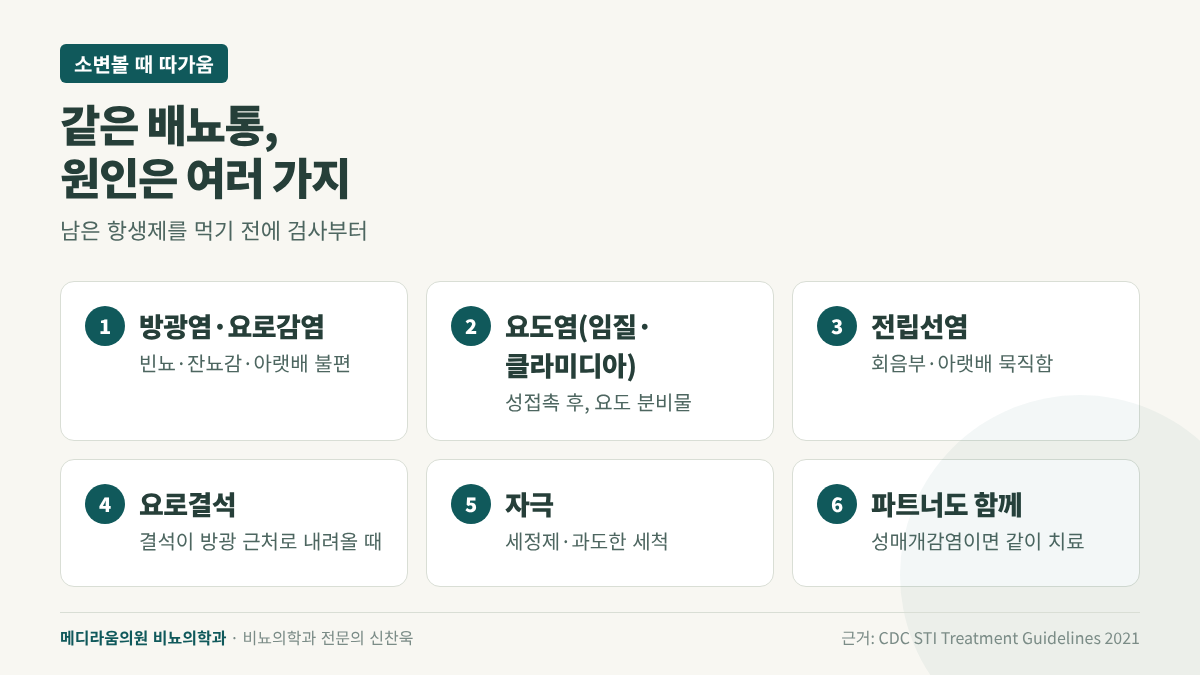
In men, burning during urination suggests urethritis first
A stinging sensation during urination is often dismissed as cystitis caused by tiredness, but cystitis is not common in men. When a man develops cystitis, we also need to consider an underlying cause such as a prostate condition or a stone. Urethritis is therefore a more likely cause of burning in many men, and when the history is consistent we check for it first. A cold and pneumonia can both cause a cough but require different treatment. In the same way, treatment for burning depends on where the inflammation is located.
Common causes of burning during urination
- Urethritis — Causes include gonorrhoea, chlamydia, and mycoplasma.
- Cystitis or another urinary tract infection — Common in women and may be accompanied by frequency, a feeling of incomplete emptying, and lower abdominal discomfort.
- Prostatitis — May be accompanied by a dull pain in the perineum or lower abdomen and a feeling of incomplete emptying.
- Urinary stone — A stone that has moved close to the bladder can cause burning and frequency.
- Irritation — For example, cleansers or excessive washing.
Features that suggest urethritis
- New burning after sexual contact
- Clear or yellow discharge from the urethral opening, or itching inside the urethra
- Testicular or lower abdominal pain
Gonorrhoea and chlamydia can cause mild symptoms or no symptoms at all. They can still be transmitted without symptoms. If untreated, infection can progress to epididymitis in men or pelvic inflammatory disease in women.
Why you should not take leftover antibiotics
Different organisms require different antibiotics, and antibiotic resistance is a particular concern with gonorrhoea. Taking antibiotics before testing can partly suppress the organism, causing it to be missed on a test and leaving treatment incomplete.
Testing and National Health Insurance
At Mediraum Clinic in Naeoe-dong, Gimhae, our basic assessment includes a urethral specimen together with urine and microscopic examination. When needed, Gram staining is used to look directly for organisms and inflammatory cells in the discharge. If broader testing is wanted, selected blood tests for infections such as syphilis and HIV can be added. Tests performed because of symptoms such as discharge, itching, or burning are covered by Korea’s National Health Insurance. Testing solely for reassurance when there are no symptoms is treated as a health-screening service and is charged at the standard non-covered rate.
Results are explained in person
Patients often ask to receive results by text message or telephone. However, these methods do not allow us to verify that the person receiving the result is the patient. Disclosing a result to someone other than the patient is prohibited under Korean medical law. Sexually transmitted infection results are also sensitive personal information, and a brief written result can easily be misunderstood. I therefore explain results in person as a rule.
Partner treatment and repeat testing
If a result is positive, we treat according to the infection and the partner should also be tested and treated to prevent reinfection. A female partner is usually advised to attend gynaecology, although women can also receive testing and treatment at Mediraum Clinic if they wish. A partner should not take the same medicine without an individual assessment.
I recommend repeating the test for the organism involved 3 weeks after treatment has finished. Testing too early can remain positive because genetic material from organisms that are already dead may still be present.
Frequently asked questions
Does burning during urination in a man mean cystitis?
Cystitis is uncommon in men, so urethritis is considered first. A urethral specimen and urine tests are used to identify the organism.
How can I tell whether burning during urination is an STI?
Symptoms alone cannot reliably distinguish the cause. A urethral specimen, urine testing, and microscopic examination are used to identify the organism.
Can I take antibiotics that I have at home first?
No. The organism may be partly suppressed and missed on testing, and an unsuitable antibiotic can leave treatment incomplete.
Does my partner need treatment after I am treated for an STI?
Yes. The partner should also be tested and treated to prevent reinfection. A female partner is usually referred to gynaecology, although treatment is also available at our clinic if preferred.
Related care: STI testing · Cystitis care
Related article
Guidelines and references
- CDC Sexually Transmitted Infections Treatment Guidelines
- EAU Guidelines on Urological Infections
- Rules on National Health Insurance Benefits, Annex 2: Non-covered services (Health Insurance Review and Assessment Service)
By Dr Shin Chan-wook, urology specialist at Mediraum Clinic, Naeoe-dong, Gimhae.
This article provides general health information. The tests and treatment you need depend on your symptoms and circumstances. Consult a clinician for an individual assessment.