A weak urine stream and frequent waking at night: checking for benign prostatic hyperplasia
Hello, I’m Dr Shin Chan-wook, a urology specialist and director of Mediraum Clinic in Naeoe-dong, Gimhae. Today I would like to discuss a weak urine stream and waking frequently at night to urinate. I will explain what we check when benign prostatic hyperplasia (BPH) is suspected and how treatment is selected.
If your urine stream has become weak and you often wake at night to urinate, BPH is one of the first conditions to check for. Medication is the foundation of treatment. Surgery is not simply a treatment one level above medication; it is closer to a last resort when symptoms genuinely cannot be managed with medicine. We must first distinguish patients who are likely to improve after surgery from those who are not.
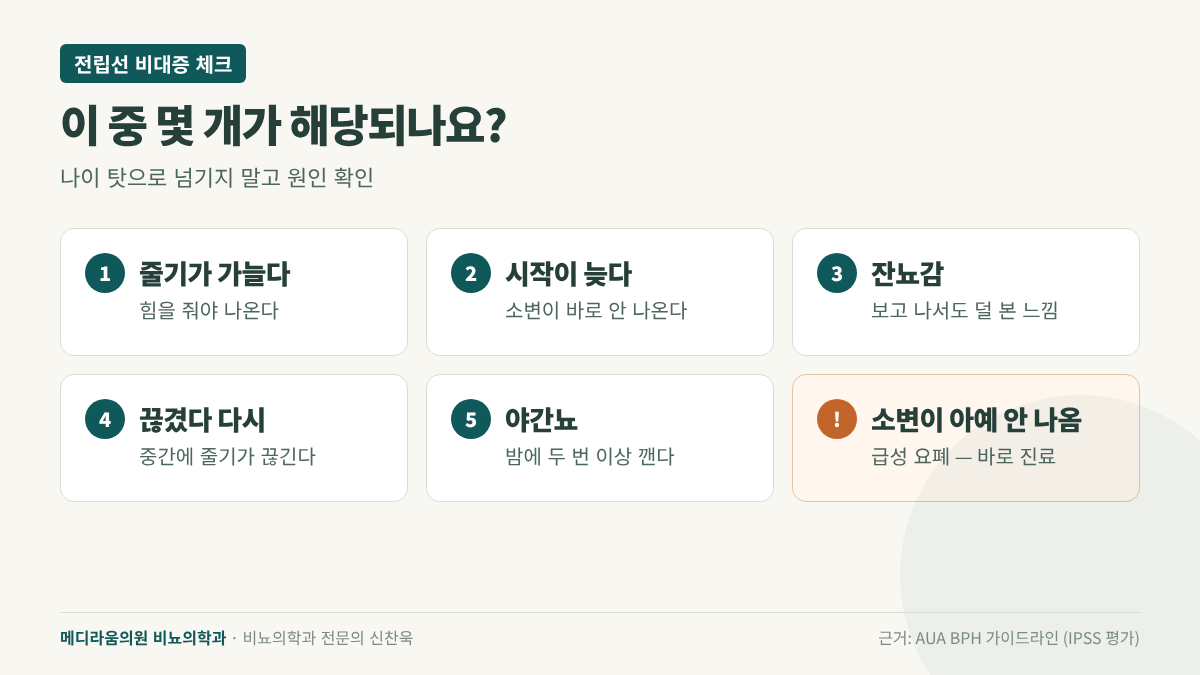
Do you have any of these symptoms?
- The urine stream is thin and you have to strain.
- Urination does not begin straight away and you have to wait.
- You feel that the bladder has not emptied completely.
- The stream stops and starts again.
- You repeatedly wake at night to urinate (nocturia).
- You also urinate frequently during the day and experience sudden urgency.
Many people dismiss these changes as part of ageing. Yet the same symptoms can arise from the prostate or from the bladder.
Tests for BPH in the clinic
When a man presents with a weak stream or frequent urination, I generally perform a prostate assessment and uroflowmetry, also called a urine flow test. For uroflowmetry, you urinate as usual into a special toilet, and the strength and volume of the stream are recorded as a graph. We then use ultrasound to check how much urine remains in the bladder after voiding. If the patient is at an age when prostate-cancer screening is appropriate, we also consider a PSA blood test. The American Urological Association (AUA) guideline likewise recommends a medical history, physical examination, symptom-score questionnaire, and urinalysis in the initial evaluation.
“I don’t want medicine, so I’ll have surgery”
This is one of the statements I hear most often in the clinic. Surgery is commonly assumed to be a more definitive, higher-level treatment than medicine, but that is not the case. Surgery is closer to a last resort when symptoms cannot be controlled despite adequate medical treatment, or when complications develop, such as complete urinary retention, recurrent infection, bladder stones, or impaired kidney function.
Consider a garden hose. If the water flows weakly, the solution depends on whether the hose is being compressed or the pump is too weak. If the prostate is compressing the urinary passage, widening that passage with surgery may help. But if the problem is weak bladder contraction, widening the passage may not strengthen the stream and symptoms can even worsen. A Korean study likewise found a lower surgical success rate among patients whose preoperative testing showed no obstruction than among those with confirmed obstruction.
I therefore do not recommend surgery indiscriminately. I first assess whether the patient’s problem is one that surgery can resolve. When surgical treatment is needed, I refer the patient to a specialist centre.
How BPH treatment proceeds
- Lifestyle measures — Reduce fluids, caffeine, and alcohol after the evening and manage constipation.
- Alpha-blocker — Relaxes the muscles at the prostate and bladder outlet to improve the urine stream.
- 5-alpha-reductase inhibitor — Reduces the size of an enlarged prostate and lowers the risk of urinary retention and surgery, either alone or in combination.
- Surgery or a procedure — Considered when symptoms are not controlled with medicine or complications develop.
A few weeks after starting medicine, we reassess symptoms and side effects and adjust treatment. At Mediraum Clinic in Naeoe-dong, Gimhae, we manage this process through regular outpatient follow-up.
When to seek care promptly
- No urine comes out at all and the lower abdomen is painfully distended (acute urinary retention).
- Urinary symptoms are accompanied by blood in the urine or fever.
Frequently asked questions
Do I have to take BPH medicine for life?
It depends on your symptoms and the condition of the prostate. Many patients remain comfortable on medicine. Any decision to stop or reduce it should be made after reassessing the symptoms together.
Will surgery mean that I no longer need BPH medicine?
Surgery is not simply a treatment one level above medicine; it is closer to a last resort when medical treatment genuinely cannot control the problem. If bladder function is the cause, surgery may not improve the symptoms, so this distinction must be made first.
How is uroflowmetry performed?
You urinate as usual into a special toilet, and the strength and volume of the stream are recorded as a graph. The test is painless and is most accurate when the bladder contains an appropriate amount of urine.
Does a weak urine stream always mean a prostate problem?
No. Weak bladder contraction, overactive bladder, or a urethral problem can also cause it, so testing is used to identify the cause.
Related care: Assessment and treatment of voiding symptoms
Related articles
Guidelines and references
- AUA Management of LUTS Attributed to BPH (2021; amended 2023)
- Usefulness of pressure-flow study in the preoperative evaluation of patients with BPH (Korean Journal of Urology 2003;44(6))
By Dr Shin Chan-wook, urology specialist at Mediraum Clinic, Naeoe-dong, Gimhae.
This article provides general health information. The tests and treatment you need depend on your symptoms and circumstances. Consult a clinician for an individual assessment.