Do I need another urology test if my health check was normal?
Hello, I’m Dr Shin Chan-wook, a urology specialist and director of Mediraum Clinic in Naeoe-dong, Gimhae. Today I would like to discuss something I often hear when recommending a urology test: “But my health check was normal.”
After listening to the symptoms and examining a patient, I may say, “Let’s repeat the urine test,” or, “Let’s look with ultrasound.” The reply is often, “Doctor, I had a health check last week. Everything was normal.”
I understand the reaction. You set aside an entire day for the check-up and the report says “normal”, so another test can sound inconvenient. This is even more understandable if you paid for additional optional tests. It is natural to ask whether such a thorough check should have found almost anything important.
However, a general health check and a test recommended in a urology clinic may have similar names but perform different jobs. Understanding that difference helps you interpret a health-check report much more accurately.
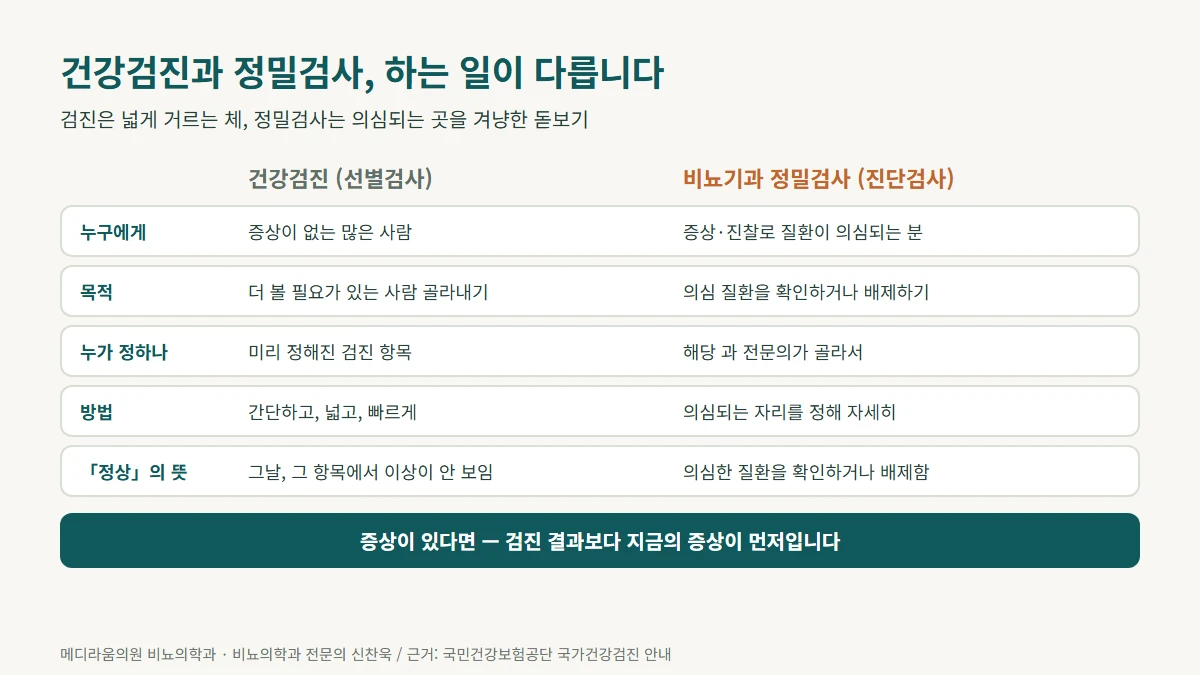
In short, a health check is the first, broad sieve used to identify people who may need detailed testing. A test recommended in the clinic is the next step, selected by the relevant specialist to investigate a suspected condition. A “normal” health check means that no abnormality was seen in the items tested on that day. It does not mean that no disease of any kind is present.
A health check is a screening sieve
The formal role of a health check is screening. Its purpose is to identify, among many people without symptoms, those who need closer examination. Screening tests are therefore designed to be simple, broad, and relatively shallow so that many people can complete them quickly and with little burden.

Imagine a sieve used to sort sand. It is excellent at removing large stones, but grains smaller than its openings pass straight through. Passing through the sieve does not mean that the sand contains nothing else. Passing a health check likewise means that nothing was caught by that particular sieve.
A urology diagnostic test is a magnifying glass aimed at a specific target
A test recommended in the clinic has a different starting point. After considering the symptoms, examination findings, medical history, and course, we suspect a particular condition and select a test to confirm or exclude it. This is called a diagnostic test, often described as a detailed examination. The specialist who knows that condition best decides which test is appropriate.
Even tests with the same name examine different depths when their purposes differ.
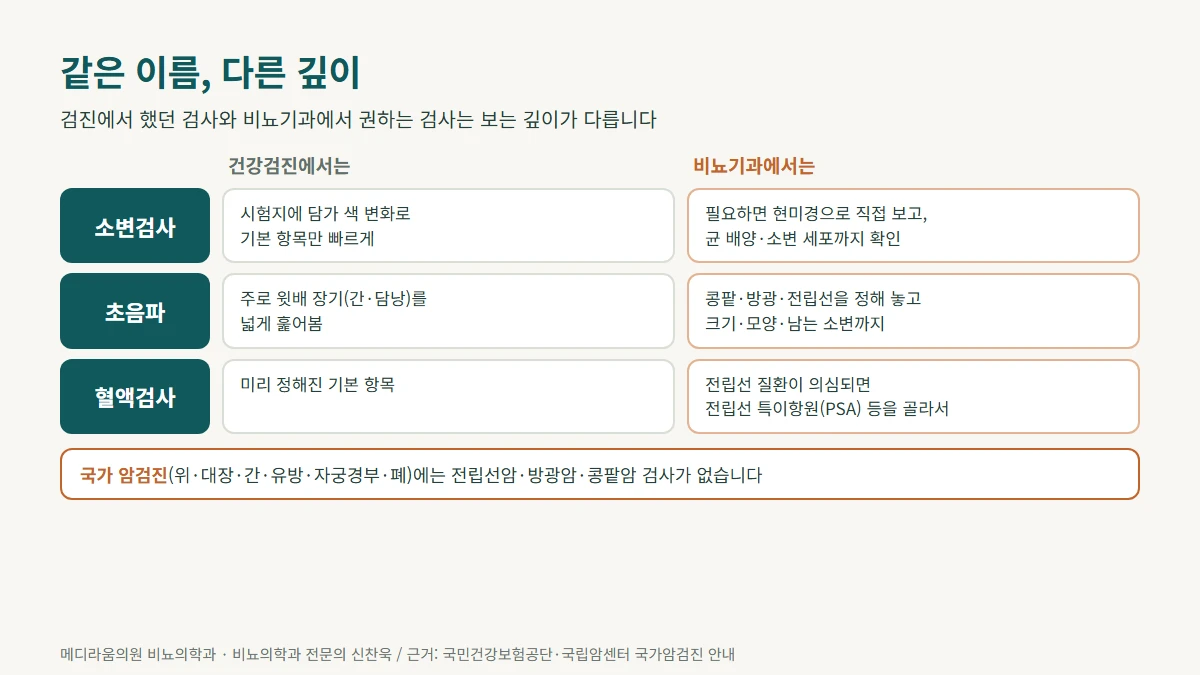
- Urine testing — A health check usually dips a test strip into urine and rapidly checks several items by colour change. In urology, depending on the suspected condition, we may examine urine directly under a microscope, culture organisms, or assess cells in the urine separately.
- Ultrasound — A screening abdominal ultrasound broadly surveys mainly upper-abdominal organs such as the liver and gallbladder. A urology ultrasound targets a suspected site such as the kidney, bladder, or prostate and assesses size, shape, and even how much urine remains after voiding.
- Blood testing — A health check measures a predefined set of basic items. A test such as prostate-specific antigen (PSA), used when a prostate condition is suspected, is selected separately for the relevant clinical situation.
In other words, diagnostic testing does not simply mean “more” tests than a health check; it means tests aimed more accurately. It follows screening in sequence and is a higher level of investigation in purpose.
Why a health check can miss a condition
This is not intended to belittle health checks. Screening is a valuable system that you should use. Understanding its limitations simply allows the report to be read correctly.
- An item not included is not examined — A health check assesses only its predefined items. Korea’s national cancer screening, for example, does not include tests for prostate, bladder, or kidney cancer. If a condition is not among the items, it was never examined; it was not confirmed to be normal.
- A simple test can miss something — A test designed to be fast and broad can miss a small or early change. Microscopic blood that is not visible may also be absent on the particular day urine is tested. No test is 100% accurate.
- A health check is a picture of that day — A symptom that began after the examination or a change that developed over time cannot appear on the earlier report.
- Optional tests are still usually screening tests — Paying for extra options usually adds several more screening sieves. Their purpose remains different from a test selected specifically for a current symptom.
When symptoms are present, the symptoms take priority over the report
This is the point I most want to emphasise. A health-check report does not explain a symptom you have now.
Screening is designed for people without symptoms. Once you have a problem—red-looking urine, a weaker stream with frequent waking at night, or flank pain—and the clinician suspects a condition after assessing it, the situation has moved from screening to diagnosis. A targeted test may be needed even if last week’s health check was normal. If you saw blood in your urine, see also the article about investigating blood in the urine.
A car analogy makes this easy to understand. If a routine vehicle inspection reports “no problem” but the brakes make a noise the next day, you would not continue driving solely because the report was normal. You would ask for the noisy part to be examined separately.
Why we recommend tests in urology
When I recommend a test, I try to explain the reason: what I suspect, what the test is intended to confirm or exclude, and what would remain unknown if it were not performed.
Good care does not mean ordering many tests. It means performing the necessary test, at the necessary time, to the necessary extent. When a test is clinically necessary, I also regard it as a doctor’s responsibility not to abandon that judgement simply because a previous health check was normal. The symptoms that should prompt a urology visit are summarised in this article.
Bringing your health-check report is actually very helpful. It allows us to avoid repeating what has already been assessed and select only what genuinely needs further investigation.
Frequently asked questions
Do I need another urology test if my health check was normal?
It may be necessary when symptoms or examination findings suggest a particular condition. Screening broadly assesses predefined items, so its purpose differs from a test aimed at the suspected disease.
Is a health-check urine test different from a urology urine test?
The purpose and method differ. Screening rapidly checks several items with a test strip. In urology, microscopic examination, culture, or other tests may be added according to the suspected condition.
Does a health check include a prostate examination?
Prostate cancer testing is not part of Korea’s national cancer-screening programme. When urinary symptoms are present or a prostate condition is suspected, the appropriate tests are selected separately during urology care.
Will adding many optional screening tests find almost every disease?
No. Most optional tests are still used for screening, so they can miss a condition, and conditions outside the selected items are not examined. If you have symptoms, seek a separate clinical assessment.
Does bringing the health-check report to the appointment help?
Yes. It helps us avoid duplicating items that have already been checked and select only the additional tests that are needed.
References
- National Health Insurance Service: national health-screening information
- National Cancer Information Center: national cancer-screening information
By Dr Shin Chan-wook, urology specialist at Mediraum Clinic, Naeoe-dong, Gimhae.
This article provides general health information. The tests and treatment you need depend on your health and circumstances. Consult a clinician for an individual assessment.