Genital herpes testing: can it still be herpes if urine PCR is negative?
Hello, I’m Dr Shin Chan-wook, a urology specialist and director of Mediraum Clinic in Naeoe-dong, Gimhae. Today I would like to discuss herpes testing, because I often hear this in the clinic: “A urine PCR test elsewhere said I did not have herpes, but the blisters have come back.”
To give the conclusion first, the most accurate test for genital herpes is PCR on a sample taken by a clinician directly from a blister or ulcer. A negative urine PCR does not prove that it is not herpes. This is not necessarily because the test was wrong; the virus may simply not have been present in the material that was tested, called the specimen.
Where does the herpes virus live?
Genital herpes is an infection caused by herpes simplex virus (HSV). Type 2 is the main cause in the genital area. In the past, I almost never saw genital infection with type 1, which commonly causes cold sores, but now I occasionally do.
The virus normally lies dormant in a nerve root, or ganglion. When a person is tired or run down, it can travel along the nerve to the skin. Clusters of small blisters then develop. When the blisters rupture, they leave shallow ulcers that later crust and heal.
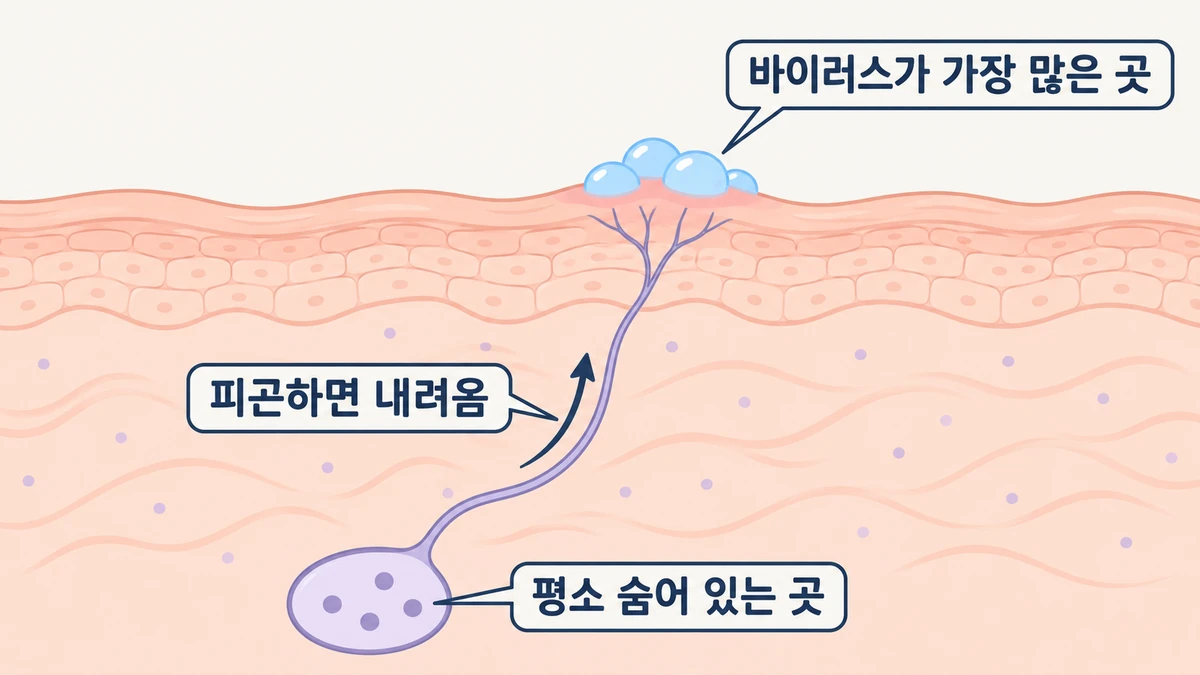
There is an important point here. The greatest concentration of virus is in the fluid inside a blister and the base of an ulcer, not in urine or blood.
How we diagnose it at Mediraum
I first examine the area directly. I assess the pattern of clustered blisters, their location, the degree of pain, and whether this is the first episode or a recurrence. When the appearance is typical, examination alone is often enough to make a clinical diagnosis.
However, several genital conditions can resemble herpes. Folliculitis, a friction injury, a syphilitic ulcer, and a drug eruption can look similar. If the appearance is uncertain, I take a swab from the affected blister or ulcer for PCR. The US Centers for Disease Control and Prevention (CDC) guideline likewise describes PCR, or a nucleic acid amplification test, from a lesion as the most sensitive test.
Why collect a sample directly from the blister?
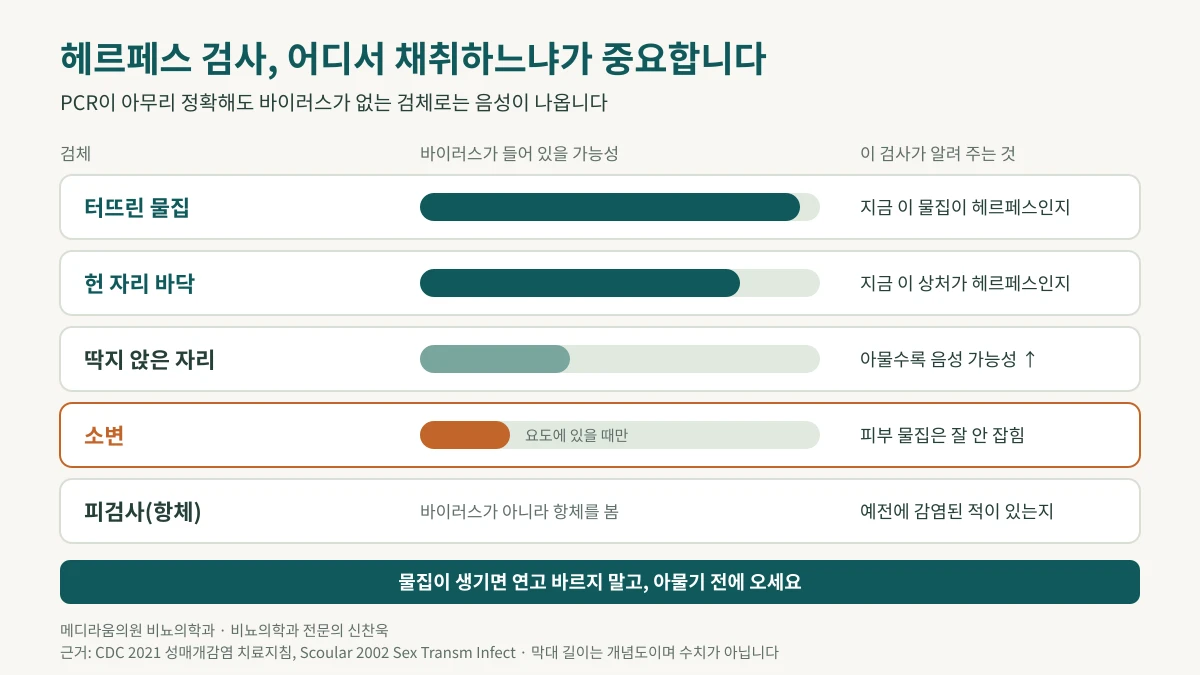
As the figure shows, each specimen has a different likelihood of containing the virus. A fishing analogy makes this easier to understand: you must cast where the fish gather. Even the best fishing rod will catch nothing in water where no fish are passing. However good the PCR “rod” is, it returns a negative result if the specimen contains no virus.
- An intact blister — contains the most virus and gives the best chance of detection.
- An ulcer — virus is readily detected in a sample collected by a clinician from the base.
- A crusted lesion — as healing progresses, the amount of virus falls and detection becomes less likely. A study from a UK genitourinary medicine clinic also found declining detection from blister to ulcer to crust.
- Urine — the virus can be detected if it is present within the urethra. However, virus in a blister on the penile shaft, scrotum, or groin is not on the path taken by urine and therefore does not mix into urine reliably.
- A blood test (antibody) — indicates whether infection occurred in the past. It cannot tell whether the current blister is herpes.
Why urine PCR can be negative
Urine PCR is not a useless test. I also use it when appropriate. Urine is an excellent specimen for finding organisms that live inside the urethra, such as chlamydia and gonorrhoea. When herpes causes urethritis, reports have also found virus in first-void urine.
However, there are several reasons why a urine test for herpes may be negative.
- When the virus is confined to the skin — if the blisters are on the penile shaft, scrotum, groin, or buttock, little or no virus mixes into urine.
- Timing of the test — once a blister has healed and crusted, the amount of virus has already fallen substantially.
- Virus is not shed continuously — the CDC guideline explains that viral shedding is intermittent, so failure to detect it does not mean that infection is absent.
- Antiviral medicine or cream was used first — treatment can reduce the amount of virus and make detection more difficult.
- Testing when no blister is present — random genital swabbing or urine testing without symptoms is not recommended as a method of diagnosing herpes.
A “negative urine PCR” should therefore be understood not as “this is not herpes”, but as “the virus was not detected in that urine specimen on that day”. If a blister returns, the best chance of an accurate diagnosis is to attend before it heals, ideally within a day or two of its appearance.
Take medicine promptly when it recurs
Herpes virus remains dormant in nerves, so current medicines cannot eliminate it completely. Used correctly, however, they can make episodes shorter and milder.
For a recurrence, antiviral medicine is most effective when taken as soon as symptoms begin. The CDC guideline explains that the greatest benefit comes from starting within a day after lesions appear, and treatment can also begin during warning symptoms such as tingling or burning. For people with frequent recurrences, we therefore agree in advance on a plan so they can start medicine immediately. Medicine used for a recurrence can be covered by Korean National Health Insurance when eligibility criteria are met.
Why does daily suppressive therapy require discussion?
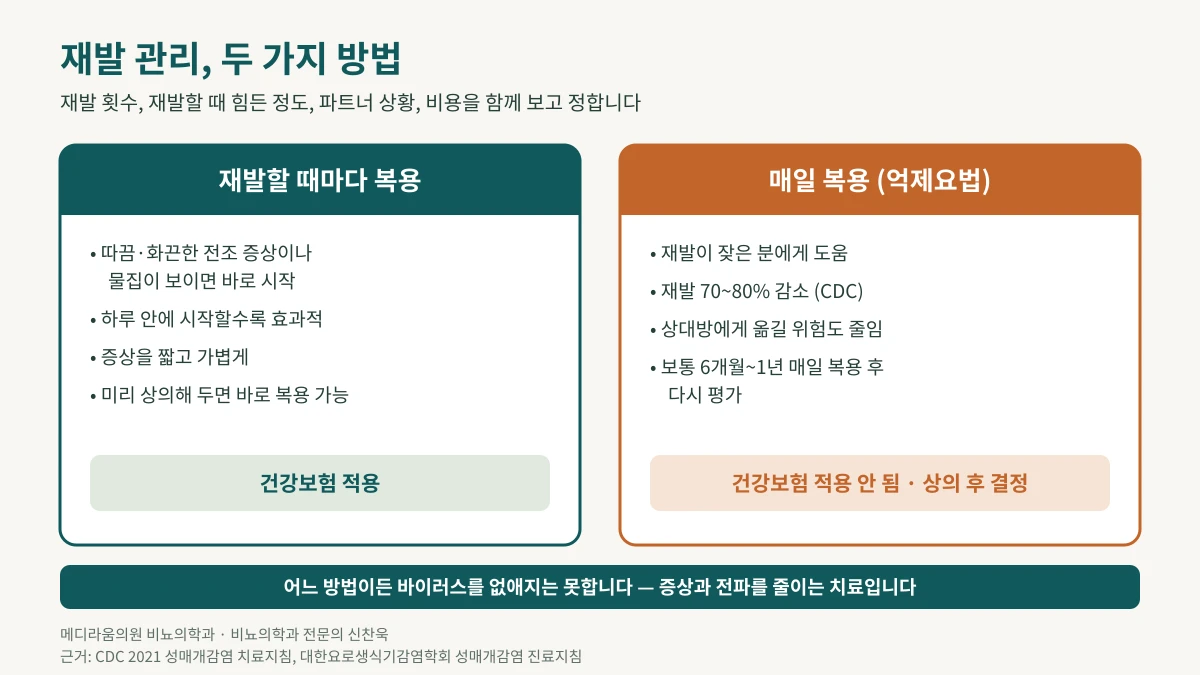
For frequent recurrences, suppressive therapy—taking medicine every day even without symptoms—can help. According to the CDC guideline, it reduces recurrences by 70–80%. In some situations it can also reduce the risk of transmission to a partner.
In South Korea, the routine suppressive regimen discussed here is usually self-pay. At our clinic we often discuss a course of 6 months to 1 year, so check coverage and cost before starting.
I therefore discuss the number of recurrences, how difficult each episode is, the partner’s circumstances, and cost. Patients who want suppressive therapy can use it without insurance coverage. Otherwise, we manage each recurrence by starting medicine promptly. In practice, many people do well with episodic treatment.
Other points to address after a herpes diagnosis
- Test for other sexually transmitted infections as well — syphilis can also cause a genital ulcer. If herpes is present, it is advisable to check for other STIs, including syphilis and HIV.
- Talk with your partner — the virus can be shed and transmitted even without symptoms. Avoid sexual contact while blisters are present. Condoms can reduce, but not eliminate, the risk.
- A first recognised episode does not mean recent infection — the infection may have occurred long ago and produced symptoms for the first time only now. The onset of a first episode does not prove that a partner transmitted it recently.
Frequently asked questions
Can it be herpes even if urine PCR did not detect herpes?
Yes. Urine may not contain detectable virus if the blisters are confined to the skin, the test was performed after healing, or viral shedding was absent at that time. If a blister returns, lesion PCR before it heals is the more accurate approach.
Can herpes be diagnosed with a blood test?
A blood antibody test indicates whether infection occurred in the past. It cannot confirm the cause or location of the current lesion on its own, so lesion PCR is preferred when a lesion is present.
Can I be tested when no blister is present?
Diagnosis is difficult in the absence of symptoms. If a blister or ulcer appears, attend before it heals if possible. Avoid self-treating, but do not delay treatment your clinician has already directed.
What is the difference between herpes types 1 and 2?
Type 1 mainly affects the lips and type 2 mainly affects the genital area, although genital infection with type 1 also occurs. Genital type 1 tends to recur less often than type 2, so knowing the type helps predict the future course.
Can herpes be cured?
The virus remains dormant in nerves and cannot be removed completely. Recurrences often become less frequent over time, and starting medicine promptly when an episode returns can shorten the symptoms.
Is suppressive therapy covered by insurance?
Medicine for an active recurrence can be covered by Korean National Health Insurance, subject to eligibility. The routine daily suppressive regimen discussed here is usually self-pay. We decide together after considering recurrence frequency and cost.
Can cold sores spread to the genital area?
When oral herpes, usually type 1, is present, it can spread to the genital area through oral contact. It is best to avoid oral contact while a cold sore is present.
Related care: STI testing and care
Related columns
Guidelines and studies
- CDC Sexually Transmitted Infections Treatment Guidelines 2021 — Genital Herpes (US Centers for Disease Control and Prevention)
- Scoular A et al. Polymerase chain reaction for diagnosis of genital herpes in a genitourinary medicine clinic. Sex Transm Infect 2002;78:21-5
- Ito S et al. Clinical courses of herpes simplex virus-induced urethritis in men. J Infect Chemother 2017
- Korean Association of Urogenital Tract Infection and Inflammation STI guideline — suppressive therapy for recurrent genital herpes (Urowiki)
By Dr Shin Chan-wook, urology specialist at Mediraum Clinic, Naeoe-dong, Gimhae.
This article provides general health information. The tests and treatment you need depend on your symptoms and circumstances. Consult a clinician for an individual assessment.