STI testing in Gimhae: when should you test after sexual contact, and which test is appropriate?
Hello, I’m Dr Shin Chan-wook, a urology specialist and director of Mediraum Clinic in Naeoe-dong, Gimhae. Today I would like to discuss the timing and methods of testing for sexually transmitted infections: when to test and which method is appropriate. I will explain step by step what you need to know when considering a test after sexual contact.
The appropriate method and the earliest reliable testing time differ among sexually transmitted infections (STDs/STIs). If you have symptoms such as burning during urination or discharge, do not wait: attend promptly. Testing for symptoms is covered by Korea’s National Health Insurance. Testing solely for reassurance when there are no symptoms is treated as health screening and is charged at the standard non-covered rate.
Do not wait when symptoms are present
- Burning during urination or discharge from the urethra
- Itching inside the urethra
- A blister, ulcer, or wart-like lesion around the genitals
- Testicular or lower abdominal pain
These symptoms can also have causes other than an STI, so a clinical assessment is needed to distinguish them. A lesion is most useful diagnostically while it is still present, so show it to the clinician before it disappears.
Without symptoms, timing depends on the exposure
Chlamydia and gonorrhoea: genetic testing
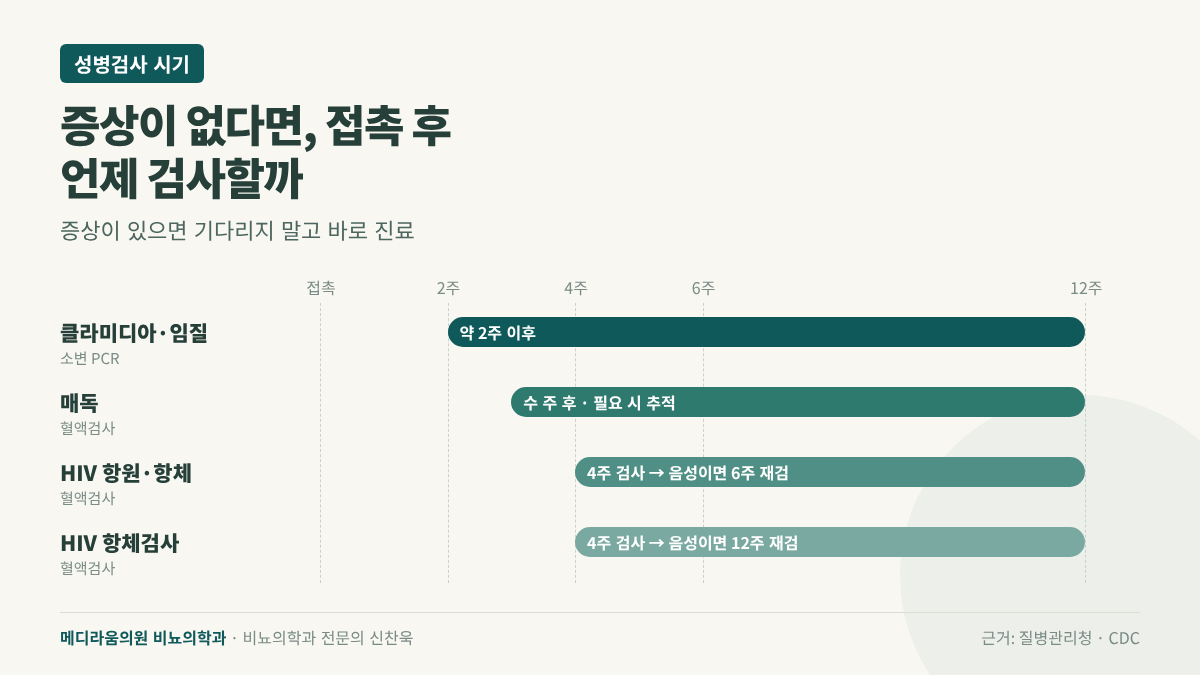
The test looks for genetic material from the organism in urine or discharge. If there are no symptoms, consider testing about 2 weeks after contact. If oral or anal contact occurred, the relevant site needs to be tested separately, so be sure to mention this during the consultation.
Syphilis: blood testing
Early in infection, the result may be negative because enough antibodies have not yet developed. Follow-up testing is selected according to the timing of the contact and the first result.
HIV: blood testing
The Korea Disease Control and Prevention Agency recommends testing about 4 weeks after exposure. If the result is negative, it recommends repeat testing after 6 weeks for a combined antigen-antibody test and after 12 weeks for other test methods. If fewer than 72 hours have passed since a high-risk exposure, do not wait for testing; seek advice about post-exposure prophylaxis (PEP).
Herpes and genital warts (HPV): examination of the lesion
We examine the lesion while it is present and, when needed, collect a specimen from it. A blood antibody test alone cannot reliably determine the cause of a current lesion or when the infection occurred.
Hepatitis B and C: blood testing
The tests needed depend on vaccination status and previous results. If you do not have antibodies to hepatitis B, discuss vaccination.
When is STI testing covered by National Health Insurance?
Coverage for the same test differs according to why it is performed, just as attending because you are unwell differs from undergoing a general health check. If symptoms suggest an STI—such as urethral discharge, itching, or burning during urination—the test is part of diagnosing an illness and is covered by Korea’s National Health Insurance.
By contrast, testing before marriage or at a partner’s suggestion when there are no symptoms is classified as health screening. It is not covered and is charged at the standard non-covered rate because preventive care not directly intended to diagnose or treat an illness is a non-covered service. Fees are listed on the fees page.
STI testing at Mediraum Clinic
At Mediraum Clinic in Naeoe-dong, Gimhae, the basic examination uses a urethral specimen. We also perform urine and microscopic examinations and, when needed, use Gram staining to look directly for organisms and inflammatory cells in urethral discharge. If broader testing is desired, we add only the blood tests that are relevant, such as tests for syphilis and HIV.
A single urine test is often assumed to detect every STI, but it does not. Syphilis, HIV, and hepatitis require blood tests, while herpes and genital warts require examination of a lesion. Accuracy depends on choosing tests that fit the circumstances.
Results are explained in person
Patients often ask to receive results by text message or telephone. However, these methods do not allow us to verify that the recipient is the patient. Disclosing a result to someone other than the patient is prohibited under Korean medical law. STI results are also sensitive personal information, and a brief written result can easily be misunderstood. I therefore explain results in person as a rule.
Partner treatment and repeat testing
If a result is positive, we treat according to the infection and the partner should also be tested and treated to prevent reinfection. A female partner is usually advised to attend gynaecology, although women can also receive testing and treatment at Mediraum Clinic if they wish. A partner should not take the same medicine without an individual assessment.
I recommend repeating the test for the organism involved 3 weeks after treatment has finished. Testing too early can remain positive because genetic material from organisms that are already dead may still be present.
Frequently asked questions
Is STI testing covered by insurance?
Testing is covered by Korea’s National Health Insurance when symptoms such as discharge, itching, or burning during urination suggest an STI. Testing solely for reassurance without symptoms is treated as health screening and is charged at the standard non-covered rate.
Is STI testing before marriage covered by insurance?
Testing for reassurance when there are no symptoms is not covered. Fees are listed on the fees page.
Can I receive an STI result by text message?
Because we cannot verify the patient’s identity by text message or telephone, we explain results in person as a rule.
Can a urine test detect every STI?
No. Some organisms are identified with urethral or urine tests. Syphilis, HIV, and hepatitis require blood tests, while herpes and genital warts require examination of a lesion.
When should STI testing be repeated after treatment?
I recommend retesting for the organism involved 3 weeks after treatment has finished.
Related care: STI testing
Related article
Guidelines and references
- Korea Disease Control and Prevention Agency: HIV testing windows
- CDC Sexually Transmitted Infections Treatment Guidelines
- Rules on National Health Insurance Benefits, Annex 2: Non-covered services (Health Insurance Review and Assessment Service)
By Dr Shin Chan-wook, urology specialist at Mediraum Clinic, Naeoe-dong, Gimhae.
This article provides general health information. The tests and treatment you need depend on your symptoms and circumstances. Consult a clinician for an individual assessment.