Has syphilis really increased in Gimhae? What changed in 2024 and when testing is needed
Hello, I’m Dr Shin Chan-wook, a urology specialist and director of Mediraum Clinic in Naeoe-dong, Gimhae. Today I would like to discuss syphilis. I will explain what recent reports of an increase mean and when a syphilis test is appropriate.
Much of the reported “surge” in syphilis, a sexually transmitted infection, reflects a change in how cases have been counted since 2024. The Korea Disease Control and Prevention Agency (KDCA) explained that, when the same criteria are used, the number reported in 2024 was actually 13.3% lower than in 2019. Statistics aside, I have nevertheless seen more patients with syphilis recently in clinical practice. If your circumstances raise concern, a blood test is the appropriate way to check.
Has syphilis really increased?
You may have seen headlines claiming that syphilis cases increased 7-fold. The graph shows reports rising from 416 in 2023 to 2,790 in 2024 and 2,211 in 2025. These bars, however, cannot be compared directly.
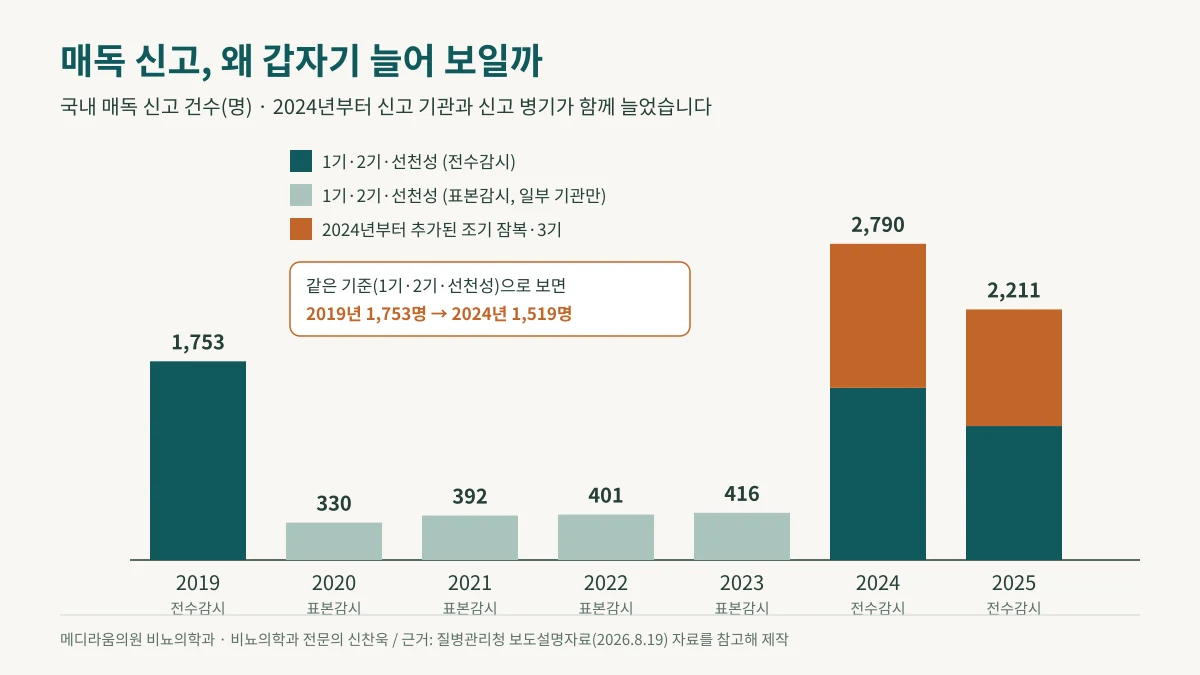
Just as changing thermometers can produce a different temperature for the same person, statistics change when the counting method changes. The KDCA stated that sentinel-surveillance figures from 2020–2023 cannot be compared directly with comprehensive-surveillance figures from 2024 onward. Comparing only the same stages—Stage 1, Stage 2, and congenital syphilis—against 2019, when the same comprehensive surveillance was used, gives 1,753 reports in 2019, 1,519 in 2024, and 1,182 in 2025.
This is not a reason to be complacent. Apart from the national statistics, I feel that syphilis has genuinely become more common in the clinic. The KDCA also reported that cases in 2024 were concentrated mainly among men in their 20s and 30s.
What changed in 2024?
- Infectious-disease classification — Syphilis changed from Class 4 sentinel surveillance to Class 3 comprehensive surveillance.
- Reporting institutions — Reporting expanded from 566 designated sentinel institutions to every medical institution.
- Reportable stages — Stage 3 syphilis and early latent syphilis were added to Stage 1, Stage 2, and congenital syphilis.
Both the number of reporting institutions and the conditions that had to be reported increased at once, so the count was bound to appear higher. The largest group among reports in 2024 was the newly included early latent syphilis, with 1,220 cases.
What is syphilis?
Many patients I meet are unfamiliar with syphilis. It is a bacterial infection transmitted through sexual contact, and its appearance changes as it progresses through stages.
- Stage 1 (primary syphilis) — A painless ulcer develops where the organism entered, such as the genitals, and then disappears on its own.
- Stage 2 (secondary syphilis) — A rash may develop on the trunk, palms, or soles. It can also settle without treatment.
- Latent syphilis — There are no symptoms, but the organism remains in the body.
- Stage 3 (tertiary syphilis) — If left untreated for a long time, it can damage the heart, nervous system, and other organs.
The fact that symptoms can disappear on their own is one reason syphilis is easily missed. Infection during pregnancy can also be transmitted to the baby.
When should syphilis testing be performed?
I perform a syphilis test in circumstances such as the following:
- A genital examination shows a lesion suspicious for syphilis.
- There has been higher-risk sexual contact, including commercial sex.
- A partner has tested positive for syphilis.
- The patient requests testing.
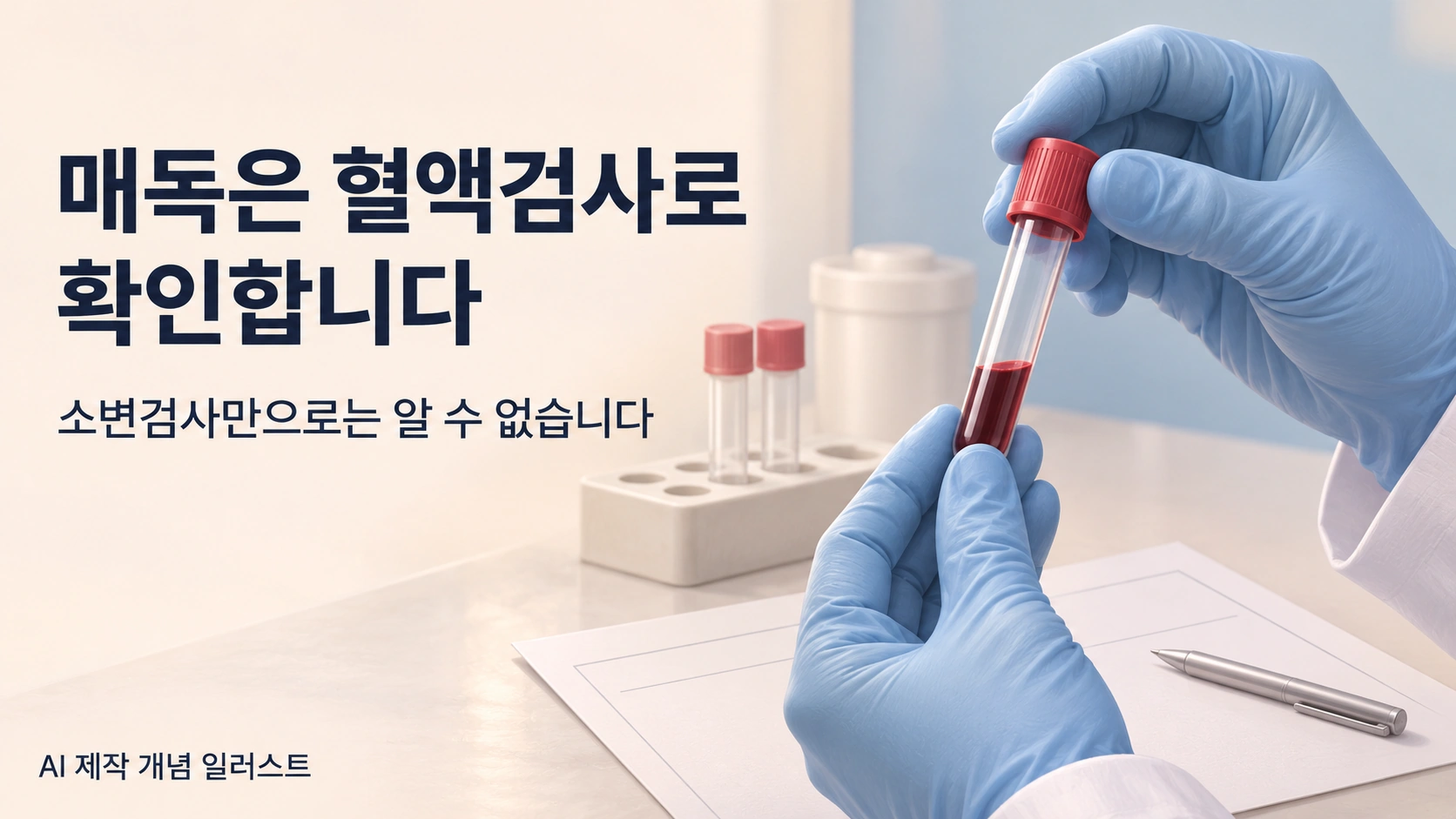
Syphilis is checked with a blood (serology) test. A urine STI test alone cannot detect it, so mention your concern during the consultation. STI testing more generally is explained in When should you have STI testing after sexual contact? Syphilis blood testing is also available at Mediraum Clinic in Naeoe-dong, Gimhae.
How is a positive syphilis test treated?
Syphilis is treated with an injection of penicillin G. A severe allergic reaction, including shock, can rarely occur after the injection, so it is safer to receive treatment in a facility equipped for an emergency response. The medicine can also be difficult for an individual clinic to obtain and stock. I therefore refer patients diagnosed with syphilis to a higher-level hospital for treatment. The partner should also be tested and treated to prevent reinfection.
Frequently asked questions
Can syphilis be tested with urine?
No. Syphilis is detected with a blood (serology) test. A urine STI test alone cannot identify it.
If syphilis symptoms disappear, has the infection resolved?
No. A Stage 1 ulcer and Stage 2 rash can disappear without treatment, but the organism can remain in the body in a latent state.
Has syphilis really increased substantially recently?
The figures appear to have risen sharply because every medical institution has reported cases since 2024 and additional stages became reportable. Using the same criteria, the figure is lower than in 2019, although I have seen an increase in recent clinical practice.
Should I be tested if my partner has syphilis?
Yes. If your partner has tested positive, you should be tested even if you have no symptoms.
Related care: STI testing
Related articles
- When should you have STI testing after sexual contact?
- Burning during urination: cystitis, urethritis, or an STI?
Guidelines and references
- KDCA explanatory release, “Comprehensive surveillance of syphilis introduced in 2024 to strengthen management” (2026.8.19)
- KDCA release on the 2025 Annual Report of Notifiable Infectious Diseases (2026.6.28)
- CDC Sexually Transmitted Infections Treatment Guidelines
By Dr Shin Chan-wook, urology specialist at Mediraum Clinic, Naeoe-dong, Gimhae.
This article provides general health information. The tests and treatment you need depend on your symptoms and circumstances. Consult a clinician for an individual assessment.