Frequent trips to the toilet: what to check first and how overactive bladder is treated
Hello, I’m Dr Shin Chan-wook, a urology specialist and director of Mediraum Clinic in Naeoe-dong, Gimhae. Today I would like to discuss overactive bladder, which can cause frequent urination and sudden urgency. I will explain the causes that should be checked first and how lifestyle measures and medication are considered together.
If you suddenly need to urinate so urgently that it is difficult to hold and this happens frequently, overactive bladder is one possibility. Treatment does not end with medicine. Lifestyle changes must accompany medication even when the medicine works well, and this is the part I spend the most time explaining in the clinic.
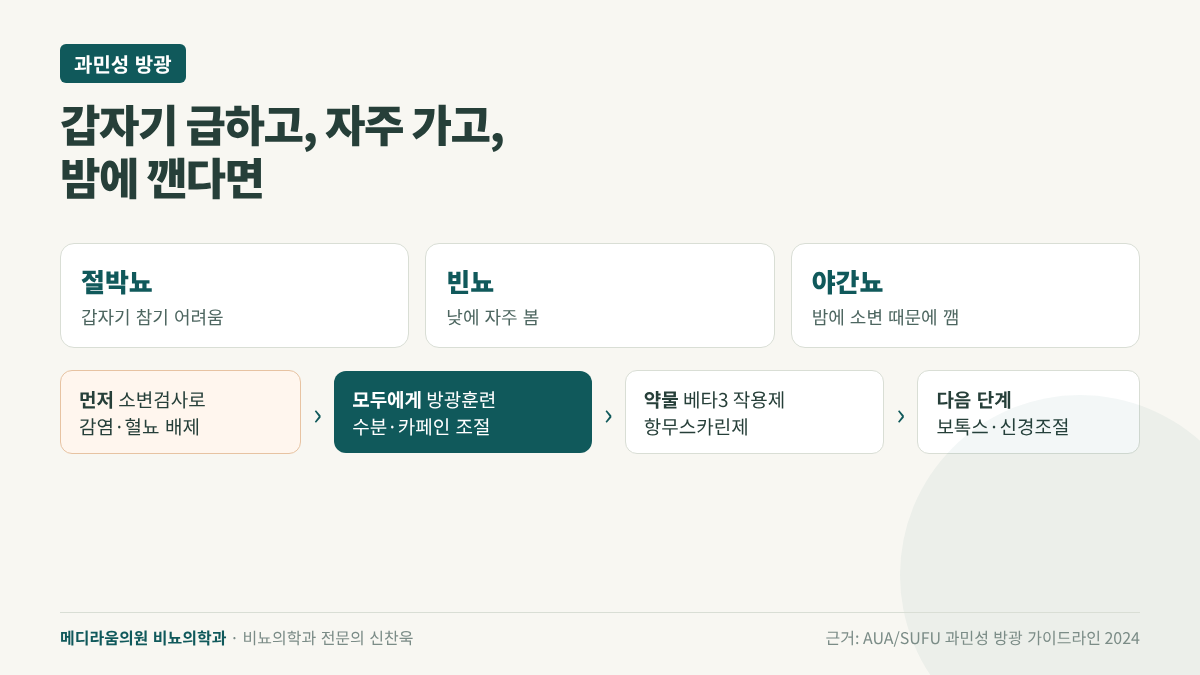
What is overactive bladder?
Overactive bladder causes a sudden, difficult-to-defer urge to urinate even when there is no clear structural abnormality or inflammation in the bladder. Imagine an oversensitive smoke alarm that sounds when there is only a little smoke. In the same way, the bladder signals that it is “full” when it contains only a small amount. It is common in both women and men, including younger people.
- Urgency — a sudden, strong need to urinate that is difficult to defer
- Frequency — urinating often during the day
- Nocturia — waking at night to urinate
- In more severe cases, urine leaks before reaching the toilet
We first rule out other conditions
Cystitis, benign prostatic hyperplasia, stones, and, less commonly, a bladder tumour or neurological disease can cause similar symptoms. The 2024 American Urological Association and SUFU (AUA/SUFU) guideline recommends urinalysis first to check for microscopic blood and infection. When needed, we also measure post-void residual urine, perform ultrasound, and review a bladder diary. In men, symptoms commonly overlap with prostate problems; see also A weak urine stream and waking frequently at night: checking for benign prostatic hyperplasia.
Lifestyle measures remain important even when medicine works
It is often assumed that daily habits can remain unchanged once medicine is started. In practice, combining medication with lifestyle measures produces a more durable benefit. The guideline recommends behavioural treatment, such as bladder training, for every patient.
- Bladder training — Instead of going to the toilet immediately at the first urge, gradually extend the interval between voids to help the bladder regain its ability to hold urine.
- Fluid and caffeine adjustment — Avoid excessive fluid intake, reduce coffee, energy drinks, and alcohol, and adjust intake after the evening.
- Pelvic-floor exercises and management of constipation and body weight
- Bladder diary — Recording when and how much you urinate reveals habits that may need to change.
Medication for overactive bladder and the next steps
Antimuscarinic medicines or beta-3 agonists are used alongside lifestyle measures. Rather than requiring each treatment to fail before moving to the next, the 2024 guideline supports choosing an appropriate option through discussion with the patient. Long-term antimuscarinic use has been reported to be associated with cognitive impairment and dementia risk. Older patients and those taking several medicines with similar effects should therefore discuss this before treatment is prescribed. If medication is insufficient, next-line options include bladder botulinum toxin injections and neuromodulation; for these treatments, I refer patients to a specialist centre.
Many people endure the symptoms because they believe they are an inevitable part of ageing. At Mediraum Clinic in Naeoe-dong, Gimhae, however, I often see daily life become easier once we identify the cause and adjust lifestyle and medication together.
Frequently asked questions
Can frequent urination be a medical condition?
If you frequently have a sudden urge that is difficult to defer and it disrupts daily life, overactive bladder is one possibility. Cystitis and prostate problems can cause similar symptoms, so testing is used first to distinguish among them.
Is medicine alone enough for overactive bladder?
Even when medicine works well, lifestyle measures such as bladder training and adjustment of fluid and caffeine intake should be continued for a more durable benefit.
Do I have to stop drinking coffee completely?
Rather than stopping at once, begin by reducing the amount and avoiding it after the evening. A bladder diary can help show how much you need to reduce.
What happens if overactive bladder medicine does not work?
We may change or combine medicines. If the response remains insufficient, we discuss next-line treatment, such as bladder botulinum toxin injections or neuromodulation, with a specialist centre.
Related care: Assessment and treatment of voiding symptoms
Related articles
- A weak urine stream and waking frequently at night: benign prostatic hyperplasia
- Burning during urination: cystitis, urethritis, or a sexually transmitted infection?
Guidelines and references
By Dr Shin Chan-wook, urology specialist at Mediraum Clinic, Naeoe-dong, Gimhae.
This article provides general health information. The tests and treatment you need depend on your symptoms and circumstances. Consult a clinician for an individual assessment.