BPH surgery is not simply the next step above medication
Hello, I’m Dr Shin Chan-wook, a urology specialist and director of Mediraum Clinic in Naeoe-dong, Gimhae. Today I would like to discuss surgery for benign prostatic hyperplasia (BPH). Many men decide for themselves that urinary difficulty must be caused by the prostate and come to the clinic asking to have surgery instead of taking medication.
To give the conclusion first, surgery is not a treatment one level above medication. It is a different treatment, appropriate for men in whom the prostate has been shown to obstruct the urinary passage.
If the cause is different, surgery may not improve the symptoms. It can even make matters worse or merely add cost.
Does every urinary problem come from the prostate?
A weak stream, frequent urges to urinate, and waking at night to pass urine are medically grouped under the term lower urinary tract symptoms (LUTS).
The European Association of Urology (EAU) guideline explains that male LUTS can arise from several causes, not just the prostate.
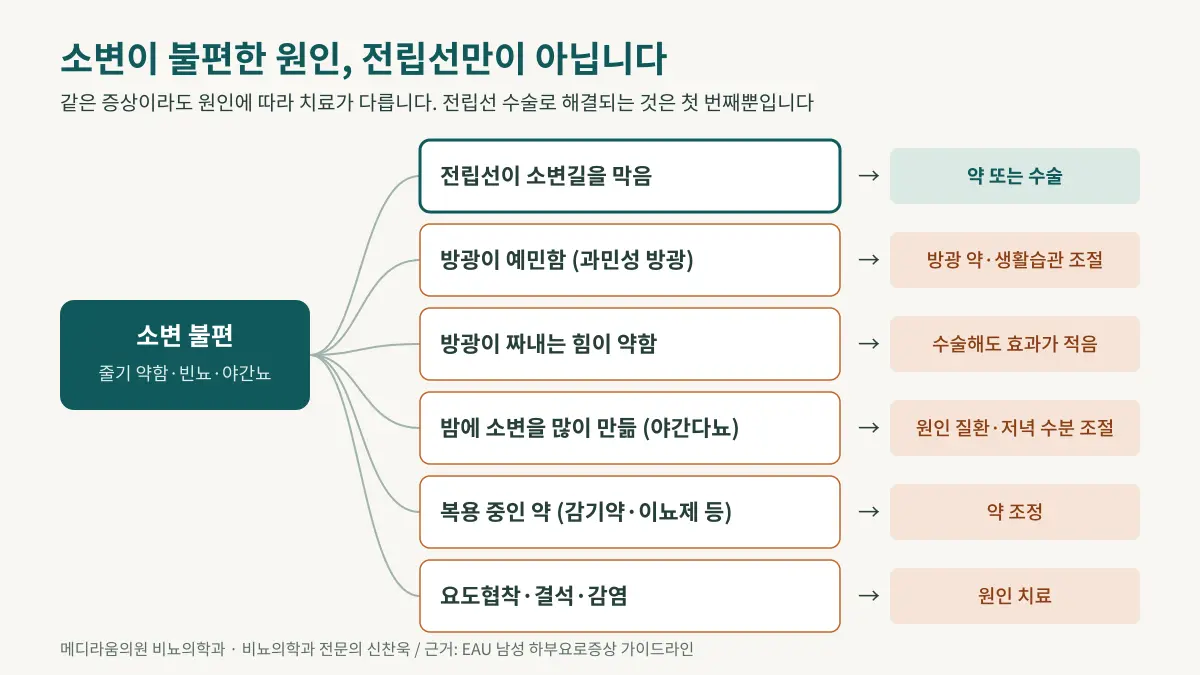
As the figure shows, there are several possible paths.
The same symptoms can be caused by an overactive bladder, a bladder muscle that contracts too weakly to expel urine, nocturnal polyuria in which too much urine is produced at night, narrowing of the urethra, infection, or a urinary stone.
Medicines you already take can also be the cause.
In a large US study, common medicines—including antihistamines in cold remedies, diuretics, antidepressants, and bronchodilators—contributed to about 10% of male LUTS.
Prostate size is not proportional to symptoms
Many men think, “I was told my prostate is enlarged, so removing some of it should solve the problem.” However, multiple studies have found only a weak correlation between prostate size and symptom scores.
A Korean study of 883 men undergoing health screening also found an association, but it was weak.
This is why some men urinate well despite a large prostate, while others have obstruction even though their prostate is not large. Size alone is not enough to decide on surgery.
What we assess before BPH surgery

For a man presenting with urinary difficulty, I routinely assess the following:
- Symptom questionnaire (IPSS) and urinalysis — the type and severity of symptoms, and whether infection or blood in the urine is present
- Prostate ultrasound — not only the size, but also whether the prostate protrudes towards the bladder
- Uroflowmetry — records the strength of the urinary stream as a graph
- Post-void residual measurement — the amount left in the bladder after urination
- Bladder diary — for men who wake at night, checks whether a large proportion of the day’s urine is produced overnight
- Medication review — checks whether any current medicine may be causing the symptoms
If these tests still cannot distinguish outlet obstruction from weak bladder contraction, a pressure-flow study (urodynamic testing) is needed before surgery.
The American Urological Association (AUA) guideline also recommends considering this test before surgery when the diagnosis is uncertain.
In a study with more than 10 years of follow-up, men whose bladder contraction was weak did not have sustained symptom improvement after surgery.
BPH surgery is not the “higher version” of medication
Think of glasses and LASIK surgery. LASIK is not a treatment one level above glasses.
The cornea must be suitable, and if the cause is different—as with presbyopia—reading glasses may still be needed after LASIK. The same principle applies to BPH surgery.

Surgery is a good treatment when the prostate has been shown to obstruct the urinary passage. Conversely, it will not resolve symptoms caused by the bladder or another condition.
Some men continue to need bladder medicine after surgery because overactive-bladder symptoms remain.
Surgery also has trade-offs. Retrograde ejaculation, in which semen does not come forwards during ejaculation, is common, and reoperation rates differ by procedure.
In a study cited by the AUA guideline, the rate of retrograde ejaculation after transurethral resection of the prostate (TURP) was 20%.
Why “I do not want medicine, so operate” does not lead straight to surgery
Wanting surgery does not by itself make someone a surgical candidate. We first need to confirm two things.
Is the symptom truly caused by obstruction of the urinary passage, and is that obstruction caused by the enlarged prostate?
In clinical practice, these two findings do not line up in quite a few men.
Some have a large prostate without obstruction. Others have obstruction whose cause is not prostate enlargement.
Neither problem is solved by an operation that removes prostate tissue.
Only when testing confirms that the prostate is obstructing the urinary passage can surgery be discussed as an alternative for a man who does not want medication.
When the AUA guideline discusses surgery for men who do not want medical therapy, it likewise presupposes that the symptoms have been attributed to BPH.
There is no sound basis for performing surgery merely because it is requested, without first confirming the diagnosis.
In my own clinic experience, fewer than 1 in 10 men who come asking for surgery actually need it.
Most achieve symptom control by taking medication consistently.
For someone already taking several medicines for other conditions, we first check whether a current medicine is contributing to the urinary symptoms.
We also start urinary medication with as few tablets as possible. The burden of taking tablets alone is not a reason to proceed directly to surgery.
Is the procedure I saw on YouTube right for me?
People now often arrive after watching videos about several procedures. However, each procedure suits a different prostate anatomy.
For example, the AUA guideline recommends prostatic urethral lift (UroLift) and water-vapour thermal therapy (Rezūm) within a prostate volume range of 30–80 g.
A prostatic urethral lift is not suitable when an obstructive middle lobe protrudes towards the bladder.
Choosing a procedure that does not fit the size and shape of your prostate may produce little benefit or lead to another procedure. Your prostate is not the same as the patient’s prostate in the video.
Your diagnosis comes before the name of a procedure.
When obstruction has been confirmed, or symptoms cannot be controlled with medication and surgery is necessary, I discuss the situation with the patient and refer him to a hospital that performs the operation. I also explain in advance which surgical approach may be appropriate.
Knowing which method fits your prostate helps you reassess the situation if a different procedure is proposed later.
Frequently asked questions
Can I stop medication after BPH surgery?
When obstruction was the cause, many men can stop medication used to improve the urinary stream after surgery.
However, bladder medicine may still be needed if overactive-bladder symptoms remain.
Can I have BPH surgery straight away if I do not want medication?
No. Surgery can be discussed instead of medication only when testing confirms that the prostate is obstructing the urinary passage.
If there is no obstruction, or if the cause lies elsewhere, surgery will not improve the symptoms.
Does a large prostate always require surgery?
No. Size alone does not determine the need for surgery. Surgery is recommended, however, when there is urinary retention, recurrent infection, bladder stones, or impaired kidney function.
Does a weak urinary stream mean BPH?
It can, but weak bladder contraction or narrowing of the urethra can also cause a weak stream. Uroflowmetry and post-void residual measurement help distinguish these causes.
Can a medicine I take be causing urinary difficulty?
Yes. Cold remedies, diuretics, and some antidepressants can contribute. Bringing a list of your medicines to the appointment is helpful.
Does Mediraum Clinic perform prostate surgery?
We investigate the cause with outpatient tests such as uroflowmetry and post-void residual measurement, and provide medical treatment.
When surgery is needed, we discuss the options and refer the patient to a hospital that performs the procedure. We also explain in advance which surgical method may be appropriate.
Related care: Voiding dysfunction care
Related columns
- BPH: checking the urinary stream and nocturia
- Overactive bladder: what to assess first and the order of treatment
Guidelines and references
- AUA Management of LUTS Attributed to BPH (American Urological Association, 2021; amended 2023)
- EAU Guidelines on Non-neurogenic Male LUTS (European Association of Urology)
- Thomas AW et al. TURP in men with detrusor underactivity: more than 10 years of follow-up (BJU Int 2004;93:745-50)
- Kim HJ et al. Prostate volume and lower urinary tract symptoms in men undergoing health screening (Journal of Urologic Oncology 2020;18:53-60)
- Kaiser Permanente. Study of common medications and male lower urinary tract symptoms
By Dr Shin Chan-wook, urology specialist at Mediraum Clinic, Naeoe-dong, Gimhae.
This article provides general health information. The tests and treatment you need depend on your symptoms and circumstances. Consult a clinician for an individual assessment.