Prostate cancer is now the No. 1 cancer among Korean men: when and how often should PSA be tested?
Hello, I’m Dr Shin Chan-wook, a urology specialist and director of Mediraum Clinic in Naeoe-dong, Gimhae. Today I would like to discuss when prostate-specific antigen (PSA) testing should begin and how often it should be performed. I will also explain how to interpret the result and decide on the next test.
In Korea’s 2023 national cancer registry statistics, prostate cancer became the No. 1 cancer among men for the first time.
Early prostate cancer causes almost no symptoms, so it is important to consider a PSA blood test.
For patients aged 40 or older, Korea’s National Health Insurance covers the test when urinary symptoms or other findings make it clinically necessary. If the value is elevated, we interpret it with other examinations and decide on the next step.
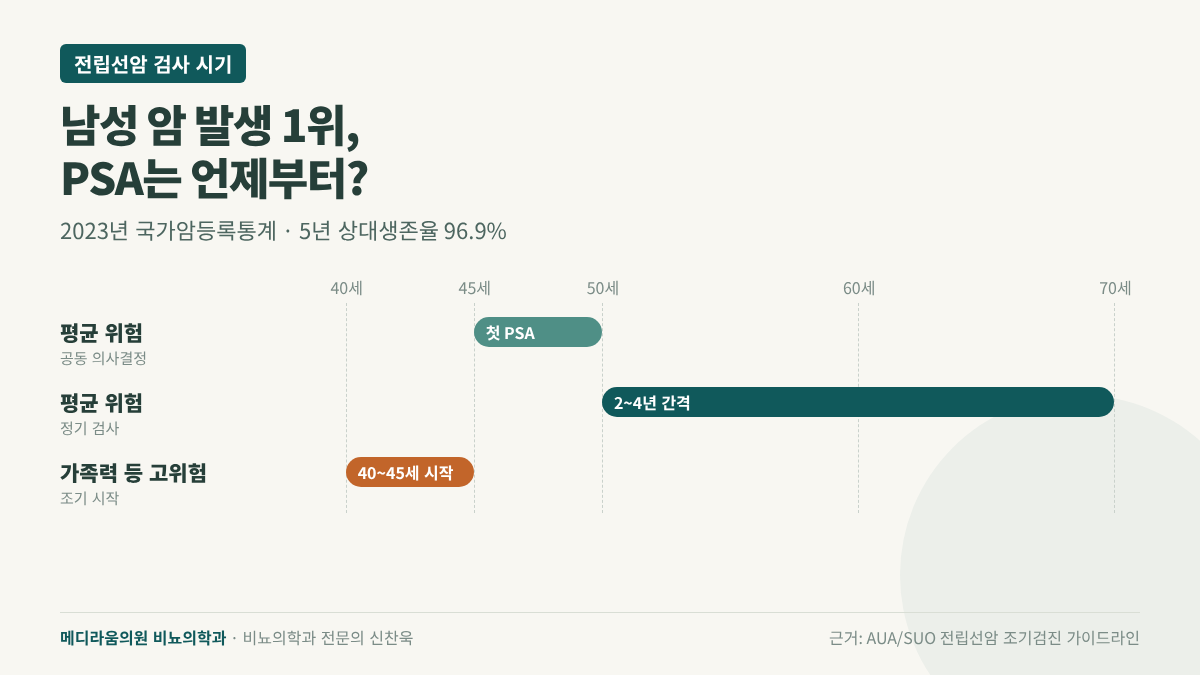
Early prostate cancer usually causes no symptoms
In the 2023 national cancer registry statistics published by Korea’s Ministry of Health and Welfare and the Korea Central Cancer Registry, prostate cancer overtook lung cancer for the first time to become the No. 1 cancer among men.
The 5-year relative survival rate for the latest 5-year period, 2019–2023, was 96.9%, indicating a generally favourable prognosis. However, this largely applies when the cancer is found early.
Survival falls markedly when it is not detected until after it has spread to the bones or other sites.
A weak urine stream often raises concern about prostate cancer, but this symptom is usually caused by benign prostatic hyperplasia. Early prostate cancer commonly has no particular symptoms.
That is why it needs to be considered through testing rather than symptoms alone.
National Health Insurance coverage for PSA testing
PSA is a protein produced by the prostate and is measured with a single blood test.
For patients aged 40 or older, Korea’s National Health Insurance covers the test when urinary symptoms or other clinical findings make it necessary. I perform it when indicated.
For a patient younger than 40, coverage may also be recognised when there is a family history or a suspicious finding on another examination.
How often should PSA be tested?
For screening, the American Urological Association (AUA) guideline recommends testing every 2–4 years from age 50 to 69, with an earlier start for people at higher risk, including those with a family history.
For patients already receiving care, I choose the interval according to the value and the clinical situation.
- When the result is stable — every 1 year
- When risk is higher or a change needs closer observation — every 3–6 months
- When we need to determine whether inflammation raised the value — repeat after 1 month
What happens when PSA is elevated?
An elevated PSA is often assumed to mean cancer, but benign prostatic hyperplasia, prostatitis, recent ejaculation, and cycling can also raise the value.
When one cholesterol result is high at a health check, we do not necessarily prescribe medicine immediately; we first reassess it.
Similarly, with PSA we consider the trend and other examinations rather than a single number.
I interpret PSA together with findings from other examinations, such as a digital rectal examination (DRE) and transrectal prostate ultrasound (TRUS).
Depending on the results, I may refer the patient promptly to a higher-level hospital for MRI and biopsy. If inflammation is suspected, we may treat it first and then repeat the test.
I explain the options fully and decide on the next course together with the patient. The AUA guideline also emphasises explaining the benefits and limitations of testing and using shared decision-making.
This is because testing can detect a very slow-growing cancer and lead to treatment that may not have been necessary.
Quality of life after treatment also matters
After prostate cancer surgery, a substantial number of patients experience urinary leakage or reduced erectile function for a period of time.
Finding the cancer earlier provides more treatment options, and in some circumstances it may be monitored with active surveillance and follow-up tests rather than treated immediately.
Mediraum Clinic in Naeoe-dong, Gimhae, provides PSA testing and outpatient follow-up.
Frequently asked questions
Is PSA testing covered by insurance?
For patients aged 40 or older, Korea’s National Health Insurance covers the test when urinary symptoms or other clinical findings make it necessary.
For a patient younger than 40, coverage may also be recognised when there is a family history or a suspicious finding on another examination.
Does an elevated PSA mean prostate cancer?
No. Benign prostatic hyperplasia, prostatitis, and recent ejaculation can also raise it. We assess it together with a digital rectal examination and ultrasound, and repeat the test after treatment when inflammation is suspected.
How often should PSA be tested?
When the result is stable, I check it every 1 year; when risk is higher, every 3–6 months. When determining whether inflammation caused the rise, I may repeat it after 1 month.
When is a prostate biopsy performed?
We consider PSA together with the digital rectal examination and ultrasound. If a biopsy is indicated, I refer the patient to a higher-level hospital for MRI and biopsy after a full discussion.
Related care: Assessment and treatment of voiding symptoms
Related articles
- A weak urine stream and waking frequently at night: benign prostatic hyperplasia
- When should you see a urologist?
Guidelines and references
- Ministry of Health and Welfare and Korea Central Cancer Registry, 2023 national cancer registry statistics (National Cancer Information Center)
- AUA/SUO Early Detection of Prostate Cancer Guideline (2023; amended 2026)
By Dr Shin Chan-wook, urology specialist at Mediraum Clinic, Naeoe-dong, Gimhae.
This article provides general health information. The tests and treatment you need depend on your symptoms and circumstances. Consult a clinician for an individual assessment.