HPV testing in men: how to interpret results and treat genital warts

Hello, I’m Dr Shin Chan-wook, a urology specialist and director of Mediraum Clinic in Naeoe-dong, Gimhae. Today I would like to discuss human papillomavirus (HPV) testing in men and genital warts. I will explain whether men should be tested and how the result should be interpreted.
I do not routinely recommend HPV testing for a man without symptoms. In practice, however, positive results are not uncommon when testing is performed.
A positive result indicates that HPV was detected in the sample, but a negative result does not prove that HPV is absent. It is important to understand this limitation before deciding to test.
Should men have HPV testing?
The US CDC treatment guideline does not recommend HPV testing as a screening test for men.
Women have an established cervical-screening method. In men, the test result does not change treatment and the testing method itself is not standardised.
In principle, I agree with this position.
The situation in the clinic is somewhat different, however.
Many men attend because a girlfriend or wife asked them to be tested, or because they heard online or in a video that men also need testing.
When a patient wants the test, I first explain how the result should be interpreted, then perform it.
How should positive and negative results be interpreted?
A fishing analogy makes this easier to understand. If you catch a fish, you know that fish are present in the pond.
If you do not catch one, however, you cannot conclude that the pond contains no fish.
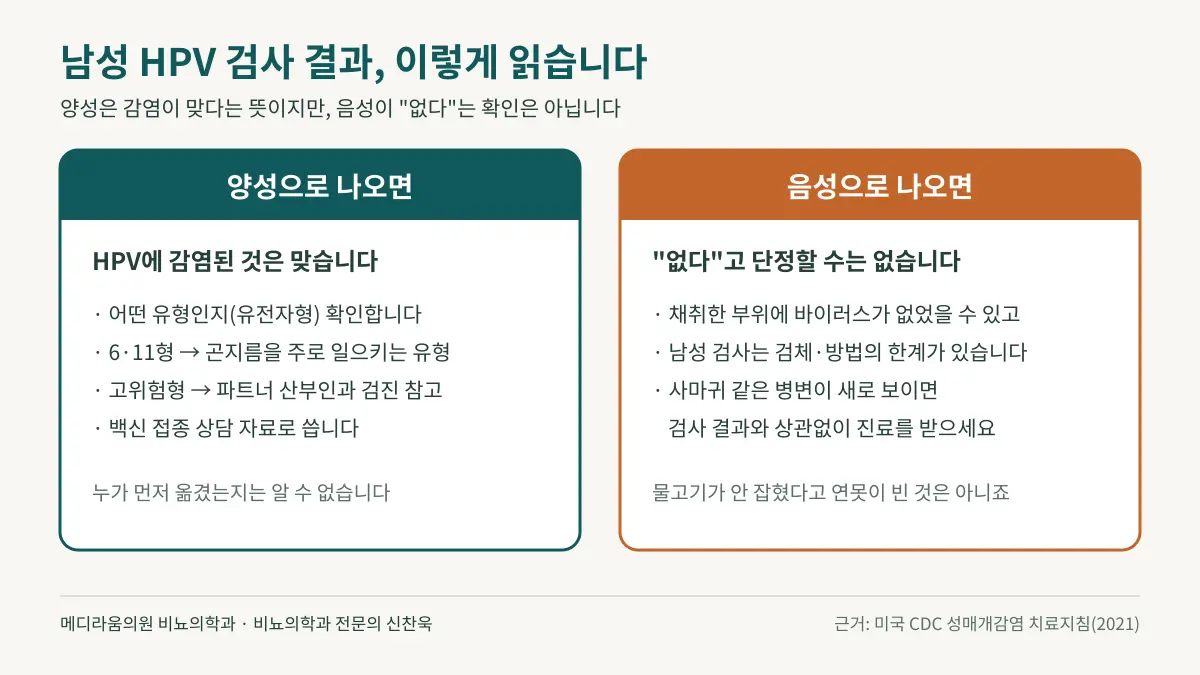
The same principle applies to HPV testing in men. A positive result means HPV was detected in the sample.
Conversely, a negative result cannot prove that the virus is absent because of limitations in specimen collection sites and testing methods.
Understanding this before testing helps avoid false reassurance or unnecessary anxiety after receiving the result.
A positive result is not a reason for excessive fear. HPV is common, and the CDC explains that 9 out of 10 HPV infections clear on their own within 2 years.
My partner tested positive for HPV. Should I be tested too?
This is the most common situation in the clinic. A partner receives a positive HPV result during cervical screening, and the couple attends together. There are two common misunderstandings.
- “I should have the same HPV type as my partner.” — Not necessarily. The type found in one partner is often not detected in the man.
- “The person diagnosed first transmitted it.” — Being detected first is not the same as being infected first. Testing generally cannot determine the order of infection.
I explain it this way: the clinic diagnoses and treats disease; investigating who was first is a detective’s job.
Please do not use test results as evidence for blaming one another.
When testing is performed, I identify the type, or genotype, and use it as clinical information.
If a high-risk type is found, I advise the partner to continue regular gynaecological screening and to consider vaccination if not already vaccinated.
STI testing more generally is explained in When should you have STI testing after sexual contact?

When genital warts develop
HPV can sometimes be detected in a sample from a wart-like lesion.
A swab can sometimes detect the virus and identify its type. Most genital warts are caused by HPV types 6 and 11. The CDC does not recommend HPV testing to diagnose genital warts or guide their treatment.
I treat the lesions with cryotherapy.
Guidelines also list medicines applied at home, but in my clinical experience they are often insufficiently effective or cause severe dermatitis at the application site, so I do not use them.
Several treatment sessions may be required depending on the number and size of the lesions.
Treatment can remove visible warts, but there is no medicine that eliminates the virus itself.
Recurrence is therefore common. The CDC explains that recurrence is particularly frequent during the first 3 months after treatment.
For most people, the body gradually clears the virus with time and the condition improves. Continue to check the area periodically after treatment and return if a lesion reappears.
Should men receive the HPV vaccine (Gardasil)?
Yes. I recommend HPV vaccination to most patients with genital warts. The vaccine is not an injection that treats a wart already present, however.
It is given to protect against other types that have not yet been acquired.
The licensed age range for men differs among vaccine products, so discuss the appropriate option during the consultation.
The cost of Gardasil 9 is listed on the non-covered fees page. HPV vaccination for men is also available at Mediraum Clinic in Naeoe-dong, Gimhae.
Frequently asked questions
Does a negative HPV test mean that a man is not infected?
No. Because of limitations in specimens and testing methods, a negative result in a man does not prove that HPV is absent. A positive result means HPV was detected in the sample.
Can an HPV result show who transmitted the infection first?
No. Being detected first does not mean being infected first, and partners often have different types detected.
Can genital warts be treated with a cream?
Guidelines include topical medicines, but I use cryotherapy because I often find that topical treatment is insufficiently effective or causes severe dermatitis.
What should I do if genital warts recur after treatment?
Recurrence is common, particularly during the first few months after treatment. Check the area yourself and return for further treatment if a wart reappears.
Is vaccination worthwhile after HPV infection?
Yes. The vaccine cannot treat a type that has already been acquired, but it can help prevent other types that have not yet been acquired.
Related care: STI testing and HPV care
Related articles
- When should you have STI testing after sexual contact?
- Has syphilis really increased? What changed in 2024 and when testing is needed
Guidelines and references
- CDC Sexually Transmitted Infections Treatment Guidelines, 2021: Human Papillomavirus Infections
- CDC Sexually Transmitted Infections Treatment Guidelines, 2021: Anogenital Warts
- CDC, About HPV
By Dr Shin Chan-wook, urology specialist at Mediraum Clinic, Naeoe-dong, Gimhae.
This article provides general health information. The tests and treatment you need depend on your symptoms and circumstances. Consult a clinician for an individual assessment.