Does vasectomy provide contraception immediately? Why a postoperative semen test is essential
Hello, I’m Dr Shin Chan-wook, a urology specialist and director of Mediraum Clinic in Naeoe-dong, Gimhae. Today I would like to discuss the point most often missed by people considering a vasectomy: the semen test after surgery.
During vasectomy consultations, I often hear the same questions: “Once I have the operation, contraception is complete from that day, right?” Patients also ask why they have to return several months later when the procedure itself is quick.
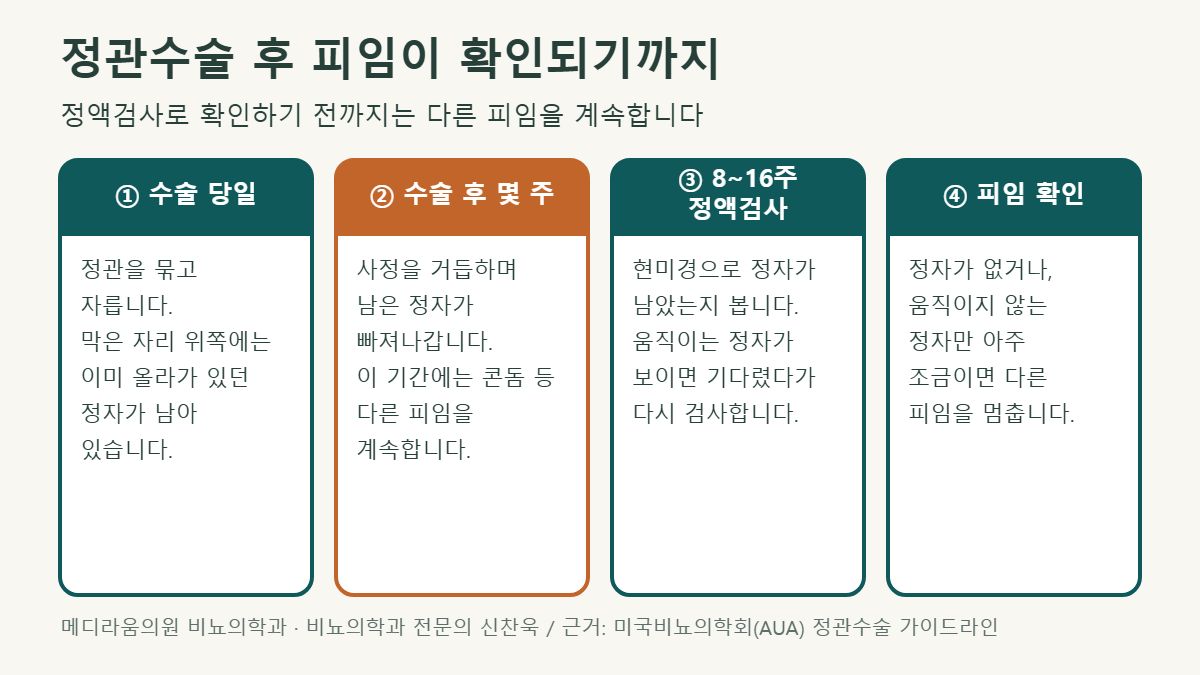
In short, a vasectomy does not provide contraception from the day of surgery. Sperm that were already present in the reproductive tract must first be cleared. Other contraception can be stopped only after a semen test 8–16 weeks after surgery confirms clearance.
What is a vasectomy?
Sperm are produced in the testes and travel through thin tubes called the vasa deferentia. Near the prostate, they join the fluid that forms semen. A vasectomy divides and closes the vas deferens on each side of the scrotum, blocking the pathway used by sperm.
Methods that use a very small skin opening or bring the vas through a single small puncture, including no-scalpel vasectomy, are now widely used. The American Urological Association (AUA) guideline also recommends these minimally invasive approaches because a smaller opening reduces bruising, infection, and pain.
Why is contraception not immediate?
When you close a tap, water already in the hose continues to come out for a while. The same applies after vasectomy. Sperm that had already travelled upward before surgery remain beyond the site where the vas was closed, including in the seminal vesicles and distal vas.
These sperm are gradually cleared through repeated ejaculations. Clearance differs among individuals, so the passage of several weeks does not guarantee that all sperm are gone. Continue another form of contraception, such as condoms, during this period.
When and how is the semen test performed?
The AUA guideline recommends semen analysis 8–16 weeks after surgery. The test is straightforward: a semen specimen is examined under a microscope to determine whether sperm remain.
- No sperm are present — Contraceptive success is confirmed, and other contraception can be stopped.
- A very small number of non-moving sperm are present — Contraceptive success is accepted when the guideline threshold is met: 100,000 or fewer non-motile sperm per 1 mL and no motile sperm.
- Motile sperm are present — Clearance may not yet be complete, or the vas may rarely have reconnected. Continue other contraception and repeat the test after an interval.
There is a reason I repeatedly emphasise this test. An unintended pregnancy after technically successful surgery simply because the confirmation test was skipped is particularly unfortunate. Please regard the semen test, rather than the operation itself, as the final step of vasectomy.
What changes after vasectomy, and what remains the same?
Many men hesitate because they worry that something about their masculinity will change. As the illustration shows, less changes than most people expect.
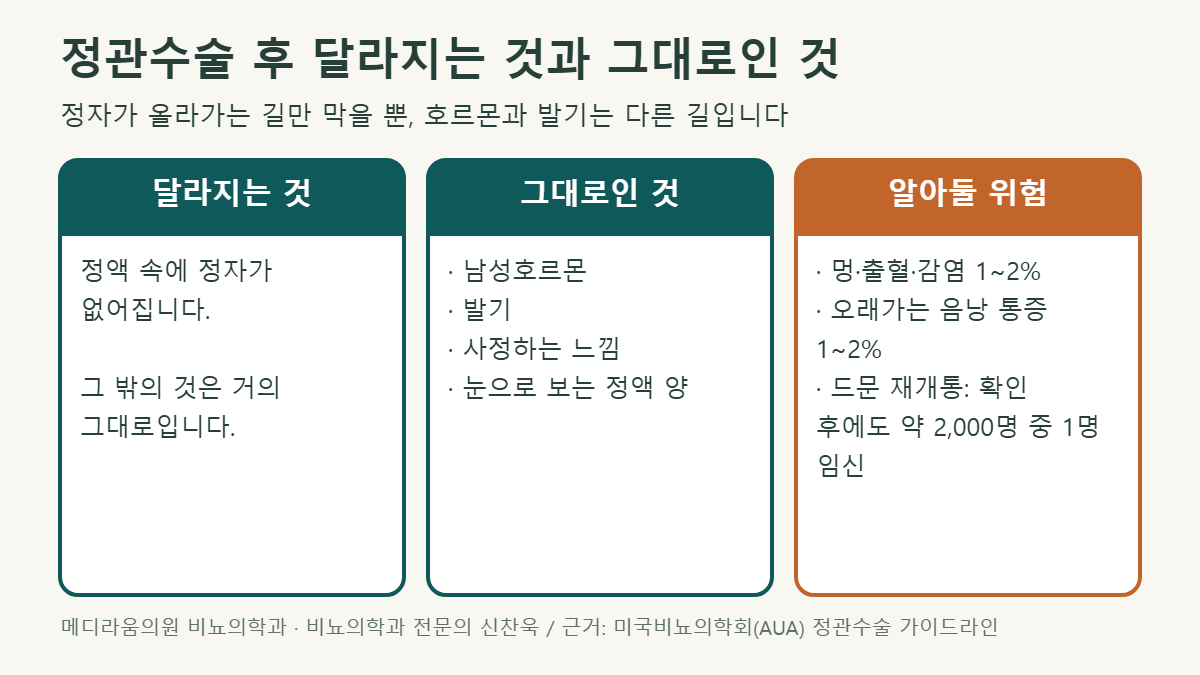
- Testosterone — Testosterone is produced in the testes and travels through the bloodstream. That pathway is separate from the vas deferens, so testosterone is unchanged after surgery.
- Erections and the sensation of ejaculation — The nerves and blood vessels responsible for erections are unrelated to the vas deferens. The sensation of ejaculation also remains the same.
- Semen volume — Most semen is produced by the seminal vesicles and prostate. Sperm make up only a very small part, so there is almost no visible difference in volume.
- Prostate cancer and heart disease — The AUA guideline concludes that vasectomy is not a risk factor for prostate cancer or heart disease.
Risks and recovery to understand
Vasectomy is a relatively simple operation, but no operation is free of adverse effects. It is better to understand them beforehand.
- Bruising, bleeding, or infection — Blood can collect in the scrotum or infection can occur in about 1–2% of procedures according to the AUA guideline.
- Persistent scrotal pain — Pain lasting long enough to require treatment is reported in about 1–2% of patients.
- Recanalisation — The divided vas can rarely reconnect. Even after clearance is confirmed on semen analysis, pregnancy is reported in approximately 1 in 2,000 cases.
Most patients can return to ordinary activities after resting and avoiding strain for about a day or two. Wear supportive underwear and avoid heavy lifting and vigorous exercise for several days. Contact us promptly if swelling or pain progressively worsens or fever develops.
What to consider before surgery
Vasectomy reversal is possible, but it is a larger operation and restoration of the tubes does not guarantee pregnancy. I therefore describe vasectomy as permanent contraception that should be chosen on the assumption that it will not be reversed.
If there is any possibility that you may want another child, do not rush. Discuss the decision fully with your partner. You are welcome to ask any questions during the consultation.
Frequently asked questions
When can I stop using contraception after vasectomy?
Only after semen analysis at 8–16 weeks shows no sperm, or only a very small number of non-motile sperm within the accepted threshold. Continue other contraception until then.
Does vasectomy reduce testosterone?
No. Testosterone is produced in the testes and travels through the bloodstream, so closing the vas deferens does not affect it.
Does vasectomy cause erectile dysfunction?
No. The vas deferens is unrelated to the nerves and blood vessels responsible for erections. If erections become weaker after surgery, it is worth checking other causes, including vascular health.
What happens if I skip the semen test after vasectomy?
You may stop other contraception without knowing whether sperm remain, leaving a risk of pregnancy. Regard the test as the final step and be sure to complete it.
Can a vasectomy be reversed?
Vasectomy reversal is possible, but it is a larger operation and pregnancy is not guaranteed. It is best to decide on the assumption that the vasectomy will not be reversed.
Related care: Men’s urology care
Related articles
- Erectile dysfunction may be a sign of vascular health problems
- Prostate cancer is now the No. 1 cancer among Korean men: when and how often should PSA be tested?
Guidelines and references
- AUA Vasectomy Guideline (2012; amended 2015)
- Sharlip ID et al. Vasectomy: AUA guideline. J Urol 2012;188(6 Suppl):2482-91
By Dr Shin Chan-wook, urology specialist at Mediraum Clinic, Naeoe-dong, Gimhae.
This article provides general health information. The tests and treatment you need depend on your symptoms and circumstances. Consult a clinician for an individual assessment.