Genital wart treatment: how do cryotherapy, excision, and laser differ?
Hello, I’m Dr Shin Chan-wook, a urology specialist and director of Mediraum Clinic in Naeoe-dong, Gimhae. Today I would like to discuss treatment for genital warts, particularly the differences between cryotherapy, surgery, and laser. Many people with genital warts, also called condyloma or condyloma acuminata, ask, “Can’t you just burn them all off with a laser in one session?”
To give the conclusion first, there is no single correct treatment for genital warts. The method is selected according to their size, number, and location. Recurrence is possible with every method, so monitoring after removal is also part of treatment.
Why do genital warts return?
Genital warts are growths of skin or mucosa caused by human papillomavirus (HPV). According to the US Centers for Disease Control and Prevention (CDC) guideline, about 90% are caused by low-risk types 6 and 11, which are not closely associated with cancer.
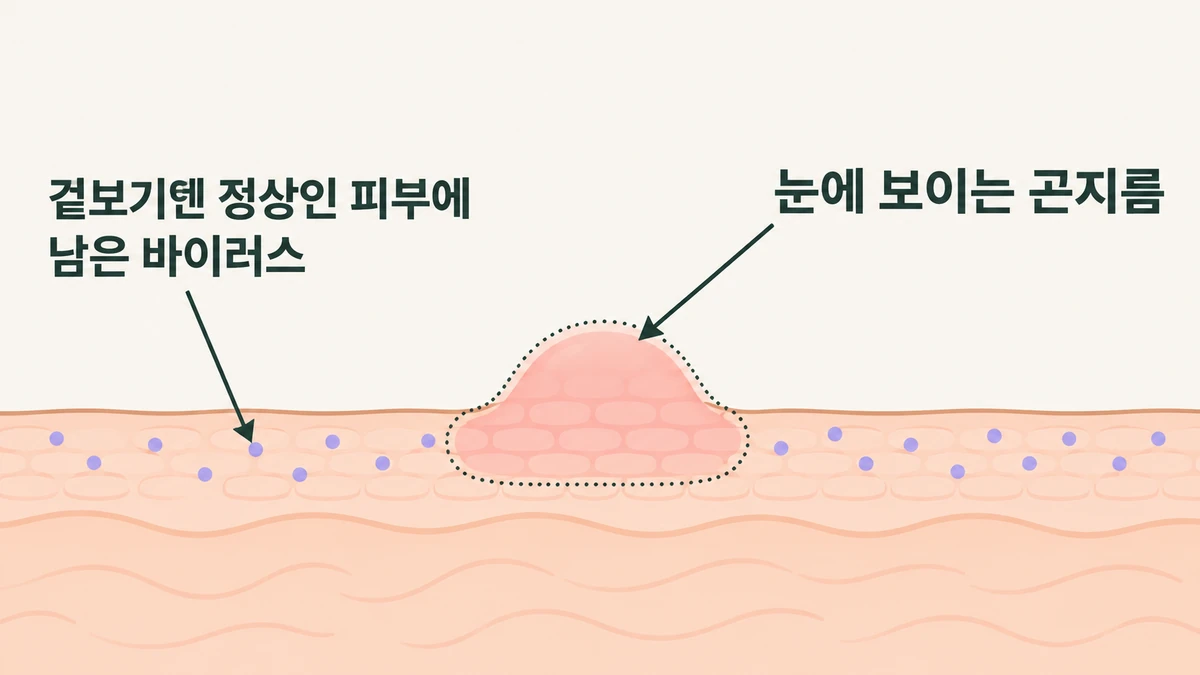
There is an important point here. Treatment removes visible warts; it does not eliminate the virus from the body. Think of weeds in a lawn. If only the leaves above the ground are cut while roots and seeds remain in the soil, the weeds can grow again. Similarly, HPV can remain in the skin around a genital wart, so recurrence is common after treatment, particularly within 3 months.
The European IUSTI guideline also reports recurrence with every treatment method, generally at a rate of 20–30%. No treatment can promise that recurrence will never occur.
3 methods of treating genital warts
There are three main clinician-administered treatments.
- Cryotherapy — liquid nitrogen freezes the wart and destroys its tissue.
- Surgical excision — after local anaesthesia, the wart is cut out. The removed tissue can be examined by histopathology.
- Laser ablation — a carbon dioxide (CO2) laser vaporises the wart.
The CDC guideline states that there is no evidence that any one of these is clearly superior to the others. Instead, it recommends choosing according to size, number, location, patient preference, cost, and adverse effects.
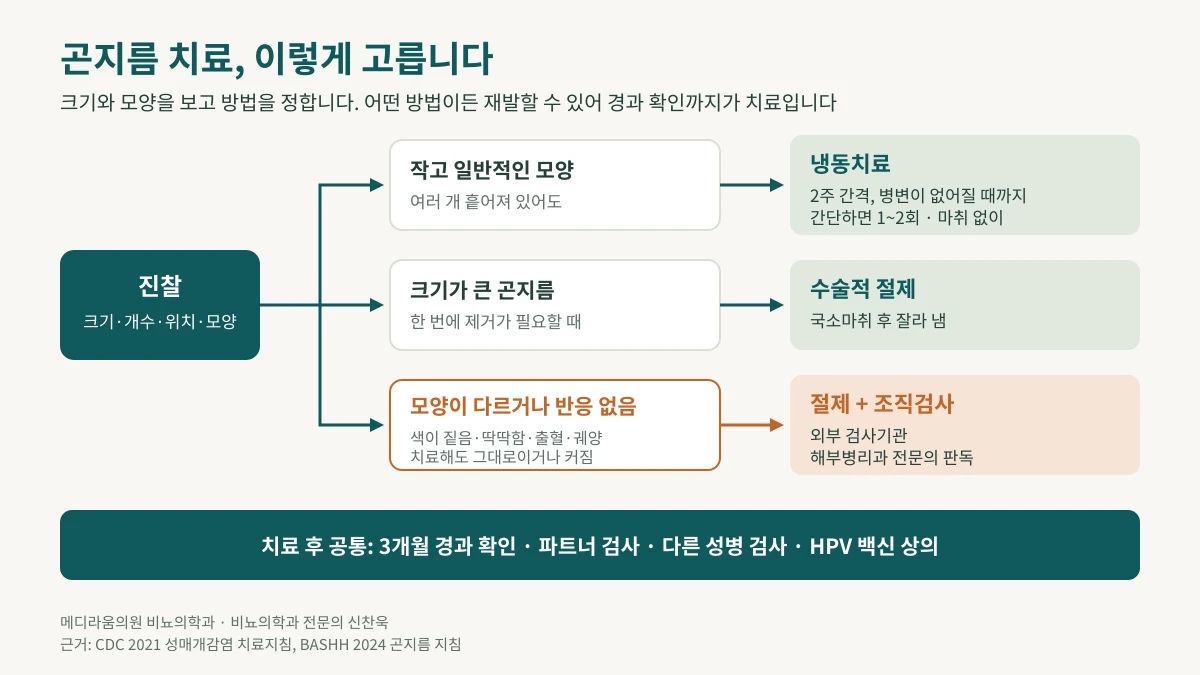
As the figure shows, the path changes according to size and appearance. This is the sequence I use to select treatment.
At Mediraum, most genital warts are treated with cryotherapy
I treat most patients with genital warts using cryotherapy, for the following reasons.
First, it does not require anaesthesia. The British Association for Sexual Health and HIV (BASHH) guideline likewise states that anaesthesia is not usually required for cryotherapy. I do not routinely apply anaesthetic cream either, because in practice it offers little benefit.
Second, scarring is uncommon. The European guideline describes cryotherapy as unlikely to scar and suitable for use during pregnancy.
Third, when several small warts are scattered over an area, multiple sites can be treated in the same session. Any residual or newly appearing lesions are treated at the next visit. Because recurrence must be anticipated with genital warts, a treatment that can be repeated with relatively little burden is well suited to the condition.
I treat at 2-week intervals until no lesion remains. A simple case may finish after one or two sessions. The treated area can sting, blister, or temporarily change colour, but these effects usually settle with time.
Guidelines also list medicines that patients can apply at home. However, it can be difficult to apply them consistently according to the prescribed schedule, and I often see inadequate effect or severe dermatitis at the application site. I therefore rarely use them.
Large or suspicious lesions are excised and examined
Not every genital wart is frozen. A large lesion is removed surgically. Excision has the advantage of removing most of the lesion in one procedure.
If the appearance is not typical of a genital wart, biopsy is performed at the same time. The CDC and BASHH guidelines recommend biopsy in the following situations:
- The lesion is dark, firm, or fixed to the underlying tissue
- It is bleeding or ulcerated
- It does not respond to standard treatment or enlarges during treatment
- It occurs in a person with impaired immunity
A lesion that resembles a genital wart may be something else. The excised tissue is therefore sent to an external laboratory for interpretation by a specialist pathologist.
Laser ablation: points to know before choosing it
Laser ablation can remove a broad area in one procedure and can help with large or extensive genital warts. The CDC guideline also mentions surgical treatment, including laser, in such cases.
However, several trade-offs should be understood before choosing it.
- Local anaesthesia is required.
- The ablated area becomes a wound and needs care until it heals.
- Laser treatment does not remove HPV from the surrounding skin, so recurrence is still possible.
- Smoke is generated as wart tissue is vaporised.
The final point about smoke deserves more explanation. HPV genetic material has repeatedly been detected in the plume produced when warts are treated with a laser. Cases have also been reported in which an HPV papilloma of the throat, or larynx, of the same type as the treated wart developed in a physician and an operating-room nurse involved in laser treatment of genital warts.
It has not yet been established with certainty that virus in the plume can infect people. Nevertheless, guidelines treat the plume as potentially infectious and recommend ventilation, smoke evacuation, and an N95 respirator.

We do not use cryotherapy because we lack a laser
To avoid misunderstanding: Mediraum Clinic performs many laser procedures for warts such as flat warts on the face, and we have CO2 laser equipment. We do not use cryotherapy for genital warts because we lack equipment or experience with laser treatment.
When laser, excision, and cryotherapy are all available, I choose cryotherapy because I judge it to be the most appropriate method for most genital warts. It can be repeated without anaesthesia or a large wound, and it produces no plume. Laser ablation is reserved for situations in which it is genuinely needed.
When lesions are widespread or keep returning
When genital warts are spread over several sites or repeatedly recur, we plan a series of treatments rather than attempting to finish everything at once. Small lesions are treated in stages with cryotherapy, while large lesions are excised.
If repeated treatment does not reduce them adequately, we discuss other treatments and, when necessary, reassess the diagnosis with biopsy.
What to remember after treatment
- Monitor for 3 months — recurrence is most common within 3 months after treatment. If a new lesion appears, treatment is easier while it is still small.
- Your partner should also be assessed — genital warts are transmitted through sexual contact. It is advisable for a partner to be assessed even without symptoms.
- Test for other STIs as well — when genital warts are present, we also check whether another sexually transmitted infection is present.
- HPV vaccination — if HPV typing results already exist, I consider them when discussing vaccination; I recommend vaccination for most patients in my practice. CDC does not recommend HPV testing to diagnose genital warts. The vaccine does not treat existing warts, but can help prevent infection with vaccine-covered types not yet acquired.
Frequently asked questions
Is cryotherapy for genital warts painful?
There can be stinging or burning during and immediately after freezing. It is generally tolerable without anaesthesia, so I do not use anaesthetic cream.
How many cryotherapy sessions are needed?
Treatment is performed at 2-week intervals until no lesion remains. A simple case may finish in one or two sessions, while more sessions may be needed depending on size and number.
Does laser treatment prevent genital warts from recurring?
No. Recurrence can occur after laser, cryotherapy, or excision because virus remains in the surrounding skin. Follow-up is important with every method.
Does Mediraum Clinic not provide laser treatment for genital warts?
We have CO2 laser equipment and use it when necessary. However, I judge cryotherapy to be the most appropriate method for most genital warts and therefore usually use cryotherapy.
Can a genital wart become cancer?
Most genital warts are caused by low-risk HPV types that are only weakly associated with cancer. If the appearance is atypical or the lesion does not respond to treatment, however, it may be a different lesion and is checked by biopsy.
Can genital warts be treated with a cream?
Guidelines include topical medicines, but applying them consistently can be difficult, and inadequate effect or severe dermatitis is common. I therefore rarely use them.
Are condyloma and genital warts the same condition?
Yes. “Genital wart” is the common term; medically, the condition is called condyloma or condyloma acuminata.
Should my partner be tested if I have genital warts?
I recommend a clinical assessment, as transmission can occur without symptoms. This does not mean the partner needs HPV typing; CDC does not recommend HPV testing for partners of people with genital warts.
Related care: STI testing and genital wart care
Related columns
Guidelines and references
- CDC Sexually Transmitted Infections Treatment Guidelines 2021 — Anogenital Warts (US Centers for Disease Control and Prevention)
- Gilson R et al. 2019 IUSTI-Europe guideline for the management of anogenital warts (J Eur Acad Dermatol Venereol 2020;34:1644-53)
- BASHH national guideline for the management of anogenital warts in adults (British Association for Sexual Health and HIV, 2024)
- Fox-Lewis A et al. Human papillomavirus and surgical smoke: a systematic review (Occup Environ Med 2020;77:809-17)
- Hallmo P, Naess O. Laryngeal papillomatosis with HPV DNA contracted by a laser surgeon (Eur Arch Otorhinolaryngol 1991;248:425-7)
By Dr Shin Chan-wook, urology specialist at Mediraum Clinic, Naeoe-dong, Gimhae.
This article provides general health information. The tests and treatment you need depend on your symptoms and circumstances. Consult a clinician for an individual assessment.